Visions of Gods and Powers, Attested and Otherwise

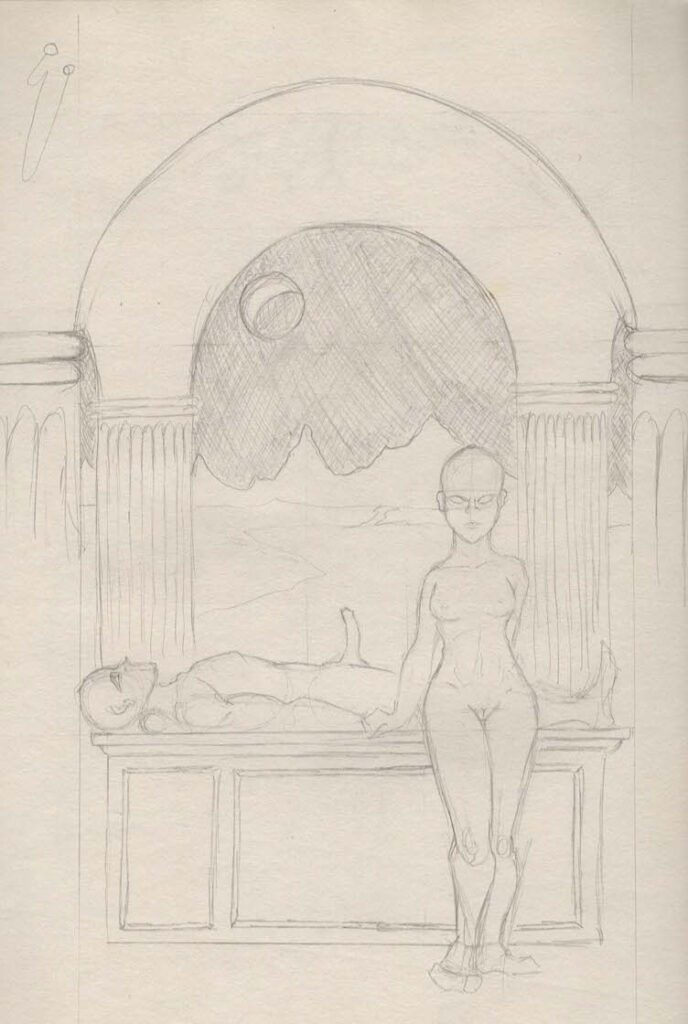
The image above is one of my first attempts to illustrate the gods and spirits I have encountered in my conjurations and explorations. I didn’t date it, so I can’t say exactly when it was done, but based on the sketchbook I found it in, and what immediately preceded and followed it, I think that this was from the Sunrise Temple period – that is to say, college, when I was still doing really intense visionary journey work and just having my first successes at contacting planetary powers – but it may have been from my first year or two back in Kansas City, after that.

The figures in the image are the Lunar intelligence(s) as they appeared to me when I made my one of my first spirit journeys to the Sphere of the Moon. I don’t know why they have (almost) always appeared to me as two spirits, unless it’s just that I took that from Agrippa’s dual-seeming sigil the intelligence of the Moon and of the spirit of the spirit of the Moon (the latter, below, being a pair of glyphs and a notion that i found repeatedly stated but never really discussed back in the day but can’t find reference to now). Nor do I know why the one figure is asleep but ithyphallic.

The next page in the sketchbook, from that same time period, is of another power, first seen a year or two (i think?) before I began my ceremonial experiments. I met her on several of my visionary journeys. She sheltered me against enemies and taught me some of what I know about navigating the Underworld.

The drawing is tragically incomplete, but it does its job. Having found this page back, I am strongly moved to return to the Underworld and re-establish this relationship, finish this drawing, and perhaps share some notes on the use of that sigil.

Honestly, I had completely forgotten these early experiments in occult art. I remembered my first masks, from 2009/10. I remembered some of my magical art plans and schemes from the late Oughts, and some my first magical self portraits from the Sunrise Temple. I remember drawing my first Picatrix image in that same time frame. But these, I had forgotten.

It’s interesting to look back on them now. For one, my illustrations are consistently better than these, now, which is nice because I often feel like my older art is better than my newest. Looking at these two, in particular, you can really see my anime roots, especially the proportions and head shape.

Later in the same sketchbook, I found more images drawn as part of my first rounds with The Seven Spheres. I feel certain that I talked about them on the Obsidian Dream Blog, but I can’t find that post back at the moment. Patreon makes sharing multiple images in the body of a post really obnoxious, so I’ll only repost a couple of my favorites, here:

The Moon and Venus, respectively these images were drawn in-circle after conjuring the planetary powers and asking for a vision.

At the same time I was doing some of the images above, I was also illustrating icons like this image of Dionysus:

and of Thanateros

My most recent magic, though, and the art I’ve done about it, has all been much more … formal. That has its advantages and disadvantages, honestly. Working from the spirit-portraits in the Picatrix, I have a source to point back to, a common ground on which my audience and I can both stand. Moreover, many of my most recent works have been some of the best drawing that I’ve done this year, which is (again) definitely not the case for the Spirits of the Spirit of the Moon and the Queen of Endless Water.

These older works are more raw, the spirits in them unattested. They also have a vibrancy and authenticity that some of my more recent images (I’m thinking, particularly, of 2023’s Image of Mercury) lack.

Once upon a time, I was a fairly prolific blogger. I shared my monthly full moon readings, and the visions I conjured at full and dark moons. I liveblogged years of experiments in chaos magick and planetary conjurations.

These last few years, I haven’t had as much to say – in words – as I would like to. Partly, that’s been the depression and the burnout and the crisis of faith that kicked off in the summer of 2023. Partly, though – and I haven’t really wrestled with this like I should, yet – it’s that I’m at a stage in my magical, spiritual, and mystical development where the things I see, the messages I receive, are really just for me and about me. As uncomfortable as it makes me, sometimes, I am deep in the Mysteries.

Somehow, these old images – these early attempts to communicate the ineffable – are a welcome reminder that creating magical images is not some weird side quest, some distraction from my real work as a witch and scholar, but rather something that I actually set out to do. That which can’t be spoken or written can sometimes be conveyed in other ways. And, even if I can’t convey my exact experience, if I can convey an image that provokes or facilitates a mystical experience in someone else, that’s as good if not better.

Because the purpose of my occult writing has never been to establish myself as an occult expert with the answer to every question. The purpose of my occult writing has always been to communicate with my peers.

This is what I’ve seen. This is what I’ve done. This is what I learned. These are the questions I am left with.

Have you seen anything like this? Does any of this resonate with you? Does it inspire you? Does it encourage you?

And, more than anything else: please, share your experiences with those with the eyes to see and the ears to hear. Come, join me in the wilderness and the void.

I am very near to completing another set (or two) of Picatrix planetary images. When I have done so, hopefully in the first months of 2026, I will almost inevitably move on to Picactrix images of the Lunar Mansions and fixed stars and maybe even the Zodiacal constellations. I also hope to resume making icons (and start making idols) of the gods to whom I have burnt and poured out so many offerings. And I hope that I will find the strength and courage to resume my explorations of the astral planes and underworld. And I hope that, in doing so, I will find the courage and the inspiration to resume my portraits of the wild and unattested powers that I found there.

And, perhaps, in the midst of that work, I will find that I have something new to say, as well.
Rite of Her Sacred Fires: Altar Pics and a Few Thoughts

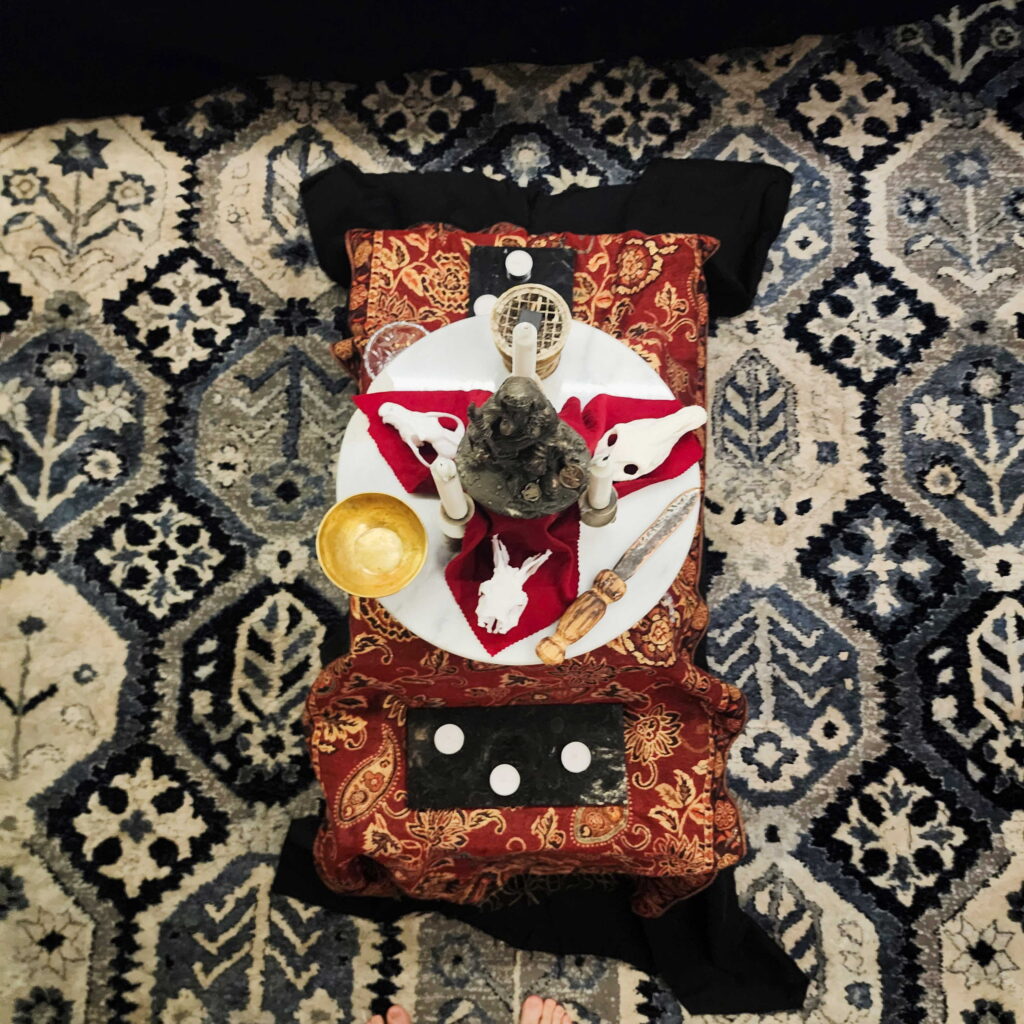
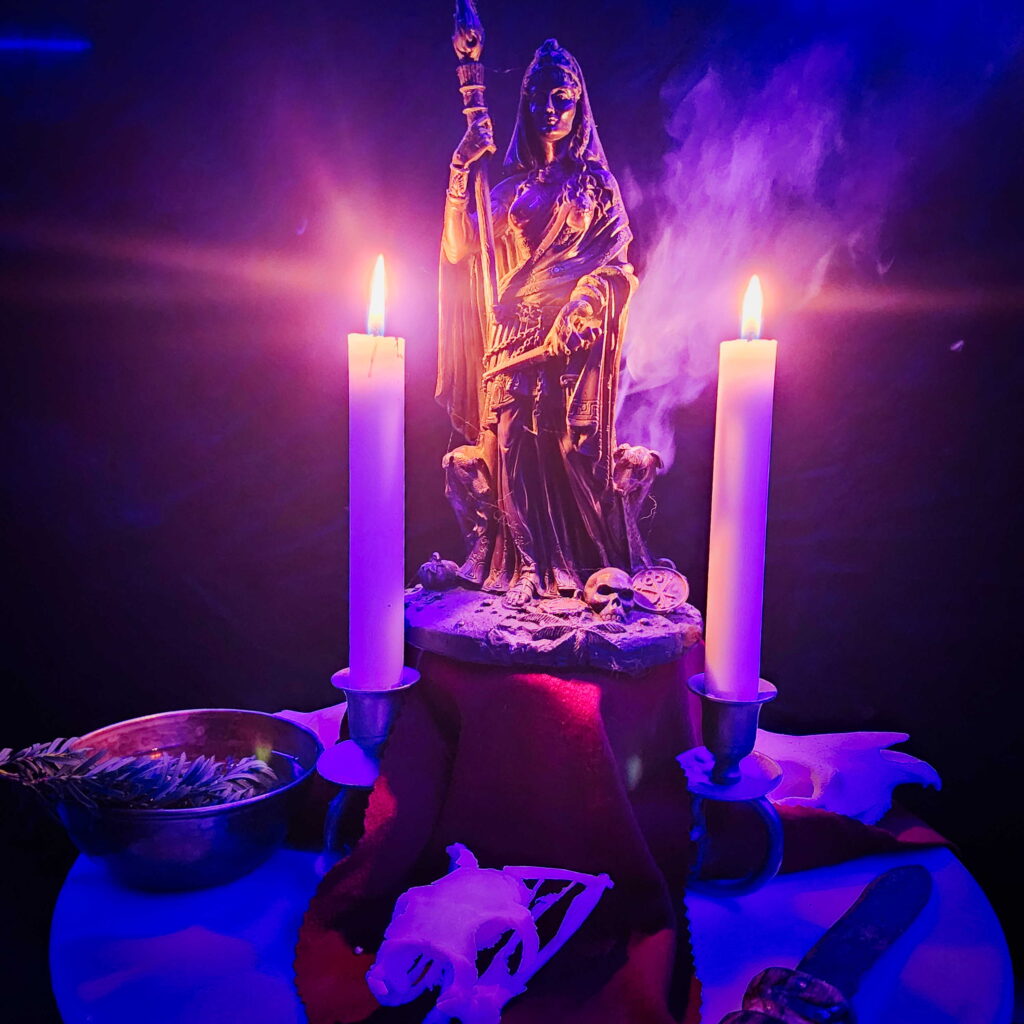
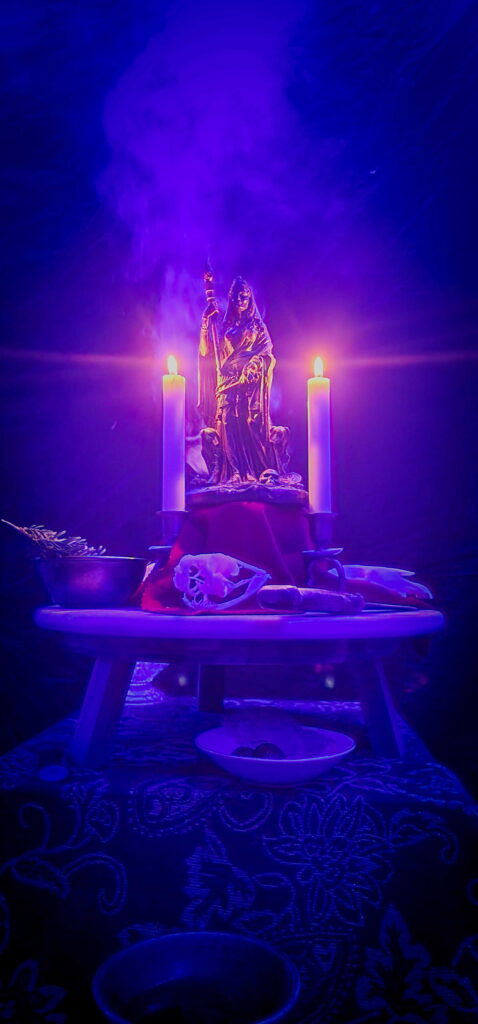
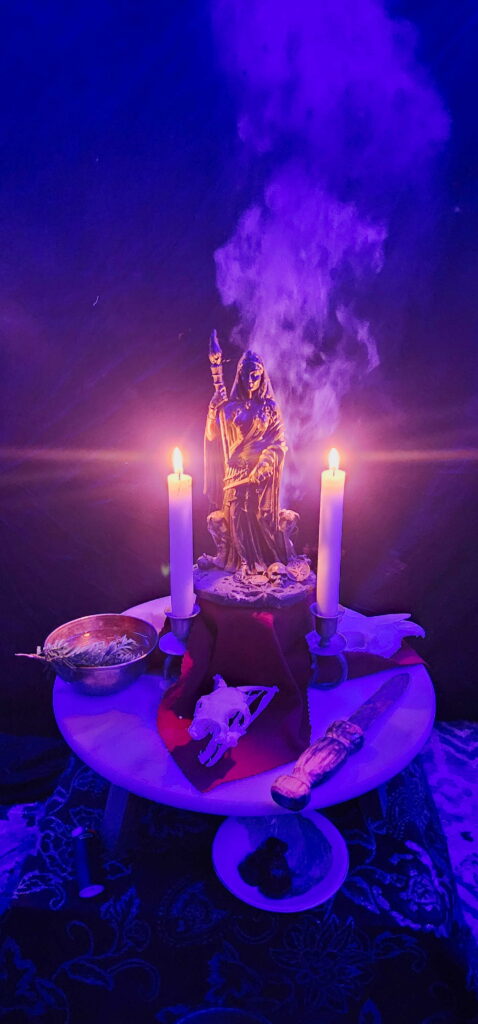
At the last Full Moon, the Lunar Shenanigans Crew and I celebrated our sixth(?) annual Rite of Her Sacred Fires. I honestly can’t remember how this one came to our attention – I think Aradia or Juniper brought it up? (This is the accidental Hekate cult, after all.) But it was definitely in the Before Times; I remember being upset that we weren’t able to do it in 2020.

We wind it up a bit, of course, to make it more our style and more a fit for a group activity. Specifically, one of us developed a Hekatean protection circle that we use, and one of us is really big on making offerings to Hestia before any ritual. Some years we’ve worked really hard to make and divide up parts so that everyone has a role. Some years, like this year, someone takes point and leads the whole thing.

It was kind of a weird year for me, and I appreciated Alvianna’s willingness to run the show. I am (as you know if you’ve read my last post, in particular) having something of a crisis of faith; I don’t even know that I could have led the ritual at all, let alone led it and got something out of it.

But I gave it my all. I went all-out on cleaning the house and building the altar. I gave the ritual my undivided attention (inasmuch as that’s a thing that even exists). I did my very best to come in good faith.

And I did get something out of it. Not as much as I have some previous years, but it … wasn’t nothing. Of course, I fucked up and didn’t write it all down right away, so my recollection is super vague, but … it was something. I almost managed some fire scrying. And the goddess was there, which I … wasn’t at all sure she would be. And the offerings were accepted, which I wasn’t sure they would be. (Yes my arrogant ass thought I could bring the whole thing down for everyone in the room.)

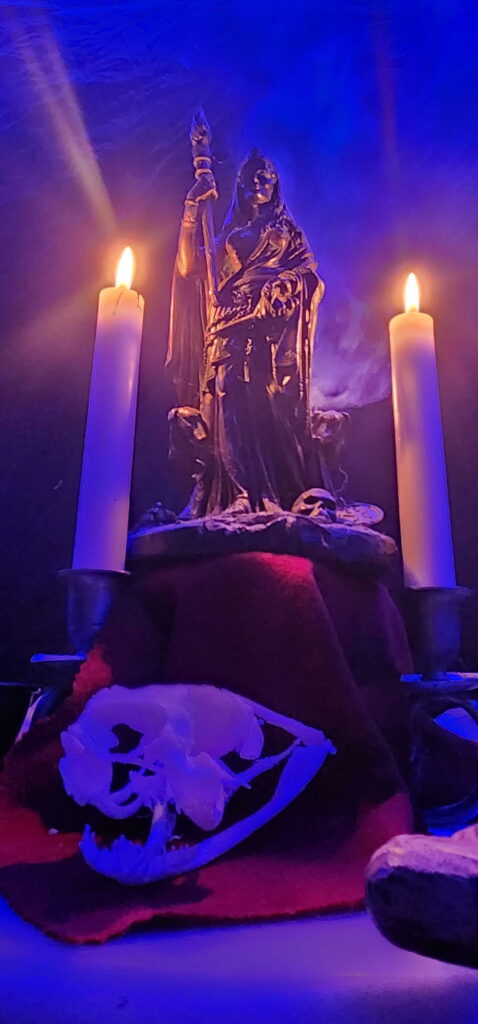
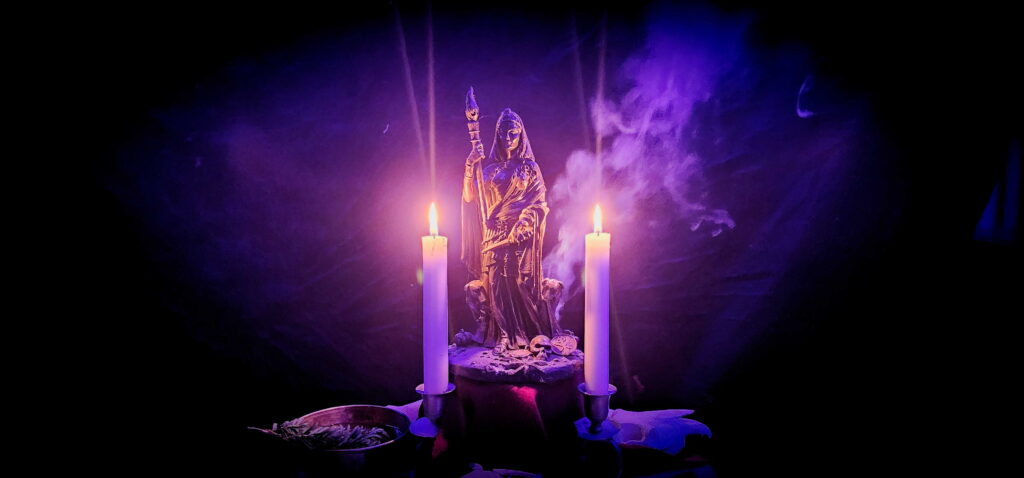
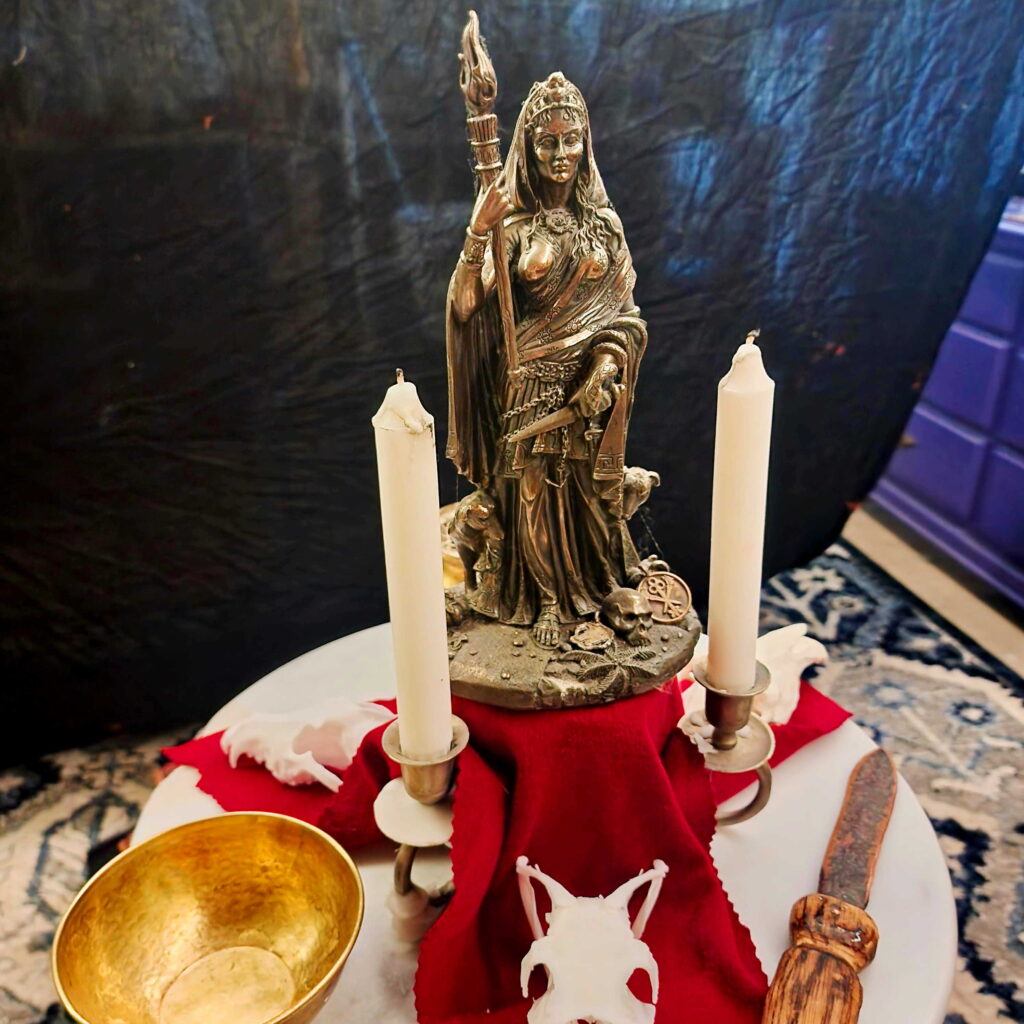
And, of course, I took pictures. Before and after (the daylight ones are before; the burning ones are after). And I’m pretty pleased with how they came out, especially the after images.

Working the Hekataeon: A Cacaphony of Gods

There are seven gods who receive daily offerings in my house. (Though I only speak of six with any regularity, there is also the Serpent Faced God of PGM XII 153-60.) As I have said before, I have no impulse toward exclusive worship – not henotheism, not monotheism, not even monism – so I had no notion of suspending those offerings when I sat down to resume the work of the Hekataeon. But it had been my intention to devote my active attention to Hekate alone. The gods, it seemed, had other plans.

In retrospect, this should not have come as a surprise.

Over the last two years, in particular, there have been times when my morning rituals have evoked intense visionary experiences. The visions that resulted in the triptych images of Baphomet, and the vision of Lucifer as the Dweller on the Threshold, were the most significant that I ever felt comfortable relating publicly. They were not, by any means, the most intense. I could feel the hands of the gods upon me, see their faces before my eyes, smell their headdy, uncanny musk.

But it seemed that I never had more than two or three visions of one god before other gods began appearing, as well. Already struggling to deal with the implications of the first visions, the addition of other powers to that mix was inevitably more than I could handle. I retreated from the experiences, and all the gods fell silent.

My friends who were raised with more religion than I was laugh at me when I wonder aloud if having been raised in a different environment would have better prepared me for these experiences. But I think they underestimate how alienated my upbringing was from divinity. In the same way I was raised vaguely aware that queer people existed, but with a strong implication that they were all far away and that I would never meet one, I was raised in a place where religion was just a social control mechanism, where people of strong convictions and intense experiences were alien and threatening. As a child, they were snake-handlers and madmen on television; as a teen, they were still that, and they were also Pat Robertson and the 700 Club: people who wanted me dead for being effeminate, for playing D&D, and for dabbling in witchcraft.

My earliest epiphanies were always of singular divinities, always months apart. They were also largely spontaneous: the presence of a god intruding on what had been intended to be some other sort of mystical experience. One of the earliest such was Rhea/Kybele appearing to demand I bring my then-friend Pasiphae to her. (I still wonder, sometimes, if that contact ever happened, or if Pasiphae’s commitment to a faceless generic Goddess was impenetrable to the real divine.)

Now, working my way through the first and then the second nine days of the Hekataeon, I am once more blessed/plagued by a cacophony of divinity. Baphomet shows me new faces every two or three days, revealing how the trinity/triptych aspects I have been shown unfold into seven (and nine) planetary epiphanies. Their Lunar aspect has much in common with the White Lady, and Saturnian Baphomet shares much with The Man in Black. Their Solar manifestation is Akephelos (Headless), and caries the Light of Creation, Phanes, like Eros. I have glimpsed their Martial aspect, bull-headed, armed and armored, which I so far call Korebantes, and that bull-headed vision gave way to another: a starry, mystical, Neptunian which I have (for lack of a better name so far) dubbed Asterion.

Aphrodite has blessed the photoshoot I did in her honor. Eros and Lucifer and Dionysos all loom large at their altars. My familiar spirits have begun speaking again on the regular, giving me practical advice for how to achieve my goals.

On days three and four and five and six of The Call, this was … unsettling. Distracting. Dissonant.

But, speaking with my compatriots at our regular New Moon Esbat, as we had all concluded our first round of The Call, those with more experience than I with the gods assured me that this was common. So, too, have a handful of people around the internet when I spoke of this problem. “Problem.”

So, even as I find the experience unsettling, I am reassured. As alien as this experience is to my upbringing and my expectations, it appears to be … typical. (As hurtful as that word is to us mystics and madmen.)

And so, as uncomfortable as it is, and as hard as it makes things from one day to the next, I am going to try to sit with that discomfort. To try to find the symphony in the cacophony.

After all, am I not a mystic? Am I not here for gnosis of the gods and the cosmos? Did I not tell Hekate, herself, that I am here to see where the road will take me? Did I not seek out each of these gods, too, even as I have sought out Hekate? Did I not seek out some of them – Dionysos, Baphomet – even before her?

This is the work. This is what I have come here to do. I have taken the names that I have taken. Each day I repeat them, both assertion and demand: I am [That Seer of Antiquity], I am [The Satyr Who Is a Magician], I am [The Sacred Companion]. I will live up to those ambitions. I will live up to those expectations.

When the gods speak, I will strive to listen.


If you want to get my posts a week before everyone else, to see the magical experiments that I don’t share with the public, to get first dibs on my elected talismans and fine art jewelry, or just want to support my work, you can do so through patreon. If you’d like to make a one-time donation, or don’t want to deal with all the non-occult content I post on patreon, I also have a ko-fi.

Devotional Image of Persephone

A couple weeks ago, the Trance Possession Club subset of my Lunar Shenanigans Crew invoked Persephone. (If I haven’t told any stories about that, oops. But everything you need for this post is contained in that sentence and the next.) I was neither Vessel nor Trance Guide, and the Vessel (who assigns roles for their ritual) hadn’t assigned additional roles, so my only task was to be ready to ask a question of the goddess when my turn came.

I’ve simplified my life a lot since we started this project, and I have really struggled to find questions to ask the gods we call on. In a couple cases, it’s been a matter of not wanting to owe that god anything, but more often – since we’ve gotten away from Hekate – it’s just a matter of having the parts of my life generally governed by those gods largely under control. So, when the question of devotional images came to me, it felt like a real moment of genius.

I asked for two images, but only got one.

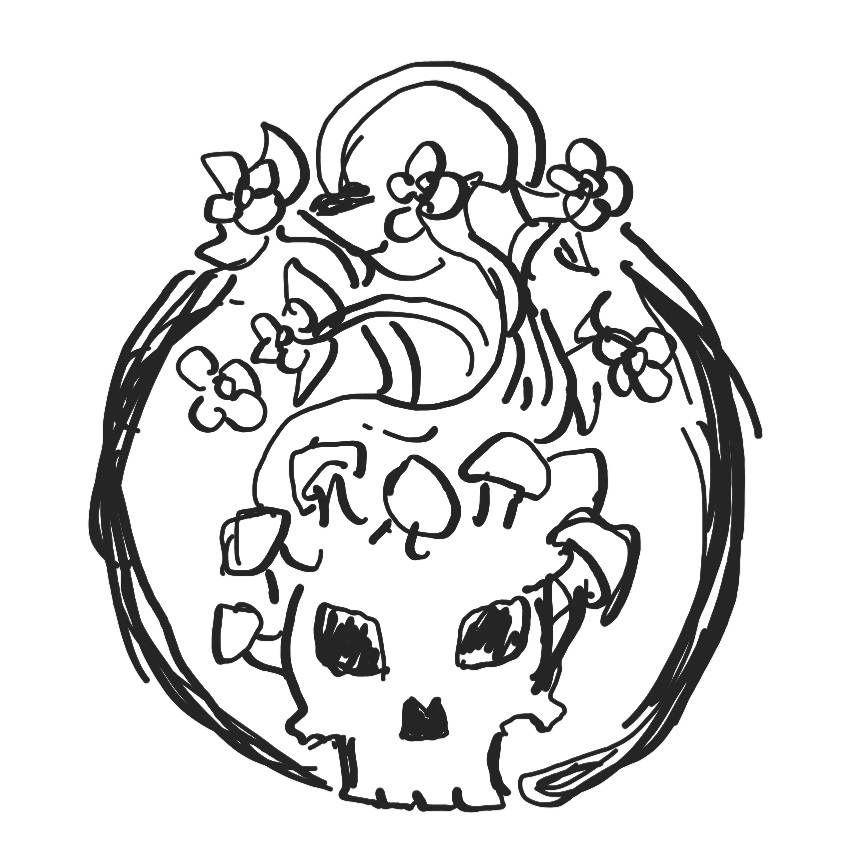
The above art is the image I received of Persephone, alone: “life and death joined … mycelium” (the lacuna there being my inability to understand the words of the oracle). I sketched this image on my phone immediately after ritual: a skull crowned in mushrooms with a flowering tree growing out of it.

This image is definitely a tier or two above my existing wax carving skill, but it’s also  too three-dimensional for my usual process, so … I guess I need to learn to be a better wax carver.

The second image I asked for was of Persephone as one of the two goddesses of the Eleusinian mysteries, for those devotees looking to discover and invent new Mysteries in that tradition. To that request, she answered: “I will say only that there was a reason I was known as the Dread Queen.” Which I partially take as, “not for you.” Which is fair, as I have no dream of rediscovering/reinventing the Eleusinian mysteries, myself, just being the personal jeweler of those who do.

It’s a little interesting and embarrassing that I didn’t think to ask that question before now. After all, I’ve wanted to create 21st Century magical images of the planets since I first started fucking with astrological image magic. For some reason, though, that didn’t translate into doing the same for the various gods my crew and I invoke.

Vision of Lucifer

I first heard the Luciferian call something like ten years ago, now. It came, perhaps oddly, the same year that I began conjuring archangels as a part of the Ceremonial Experiment. I was still, in a very real sense, new to working with gods of any kind, and god-like powers at that scale. And I was still the product of my youth in the tail end of the Satanic Panic: I had spend the first five, maybe ten, of my practice trying to convince onlookers that we were not Satanists, that most witches don’t even believe in the Devil. So, though the metaphorical phone kept ringing, I refused to answer.

The call kept coming. Little signs. Songs. Visions. And I kept putting it off. Putting him off.

I don’t remember exactly when I changed my mind and decided to answer the call. I think it was a craft night with the coven. I was making a mask and it … went in a direction. And I figured that was as good a place to start as any. And I recommitted to the work in Beltane of 2019, when I made a star talisman in Luciferian colors during another Lunar Shenanigans craft extravaganza. I put those tokens on a shelf in the spare room where I kept my personal altar, but it didn’t really go any further than that.

The work really only started in the fall of 2020, when the daily offerings to my familiar spirits escalated into daily offerings for the gods who shared the space of my altar room. From there it was slow escalations.

The visions began early this year, when I quit my day job to pursue art and magic full time. I was going around the altars, each day asking one of the gods in that room to initiate me into their mysteries. And I had put Lucifer off for so long that, at first, he refused. Since then, though, he has begun revealing aspects of himself to me.

Whether or not you believe that the being I am calling Lucifer is the Devil at odds with That One God depends a lot on how you see him.

To me he is a Promethean figure: a bringer of light and magic, a teacher of art and mysteries. He is the Peacock Angel of the Yazidis. He is Melek Taus of the Anderson Feri tradition.

He is a Gnostic power: bringing light and wisdom to mortals, kindling and sheltering their fire against the dark of the universe and the malice of the demiurge and the archons.

He has presented himself to me as the Dweller on the Threshold: the terrifying image meant to keep the weak from the mysteries. To pass him, one needs only sufficient courage.

He has presented himself to me as the Light in the Darknesss: the light-bringer, literally.

And he has presented himself to me as transmasculine, or perhaps as an androgyne opposite and equal to the full-breasted and tumescent androgyny of Baphomet.

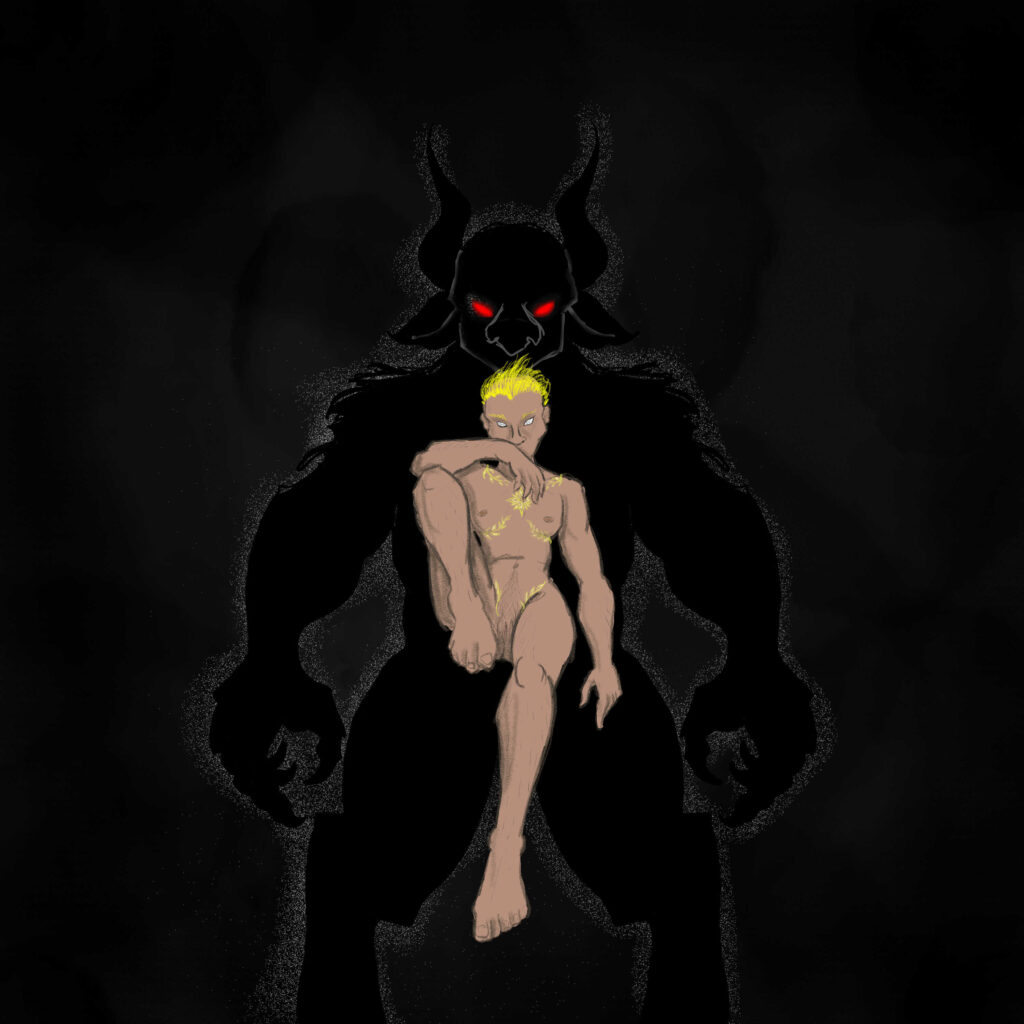
In this image, I have done my best to evoke all of these, and to recreate the visions of Lucifer that I have seen in my morning meditations. This is a first attempt. It will not be my last.

Hekate: An Unexpected Devotion

This week has marked an anniversary, half-forgotten in the madness of 2018. This time last year, my working group participated in the global Rite of Her Sacred Fires. It was not the first time I had invoked Hekate, but it was the most significant up to that point.

I must emphasize “up to that point”. Hekate began to appear more frequently on our docket, culminating in a devotional Samhain ritual in which I make made myself a vessel for her so that my compatriots could approach and petition her for aid. Three months after that, Jack Grayle’s Hekataeon went live. Aradia and I dove in head first. Our copy arrived just in time for Paganicon, and we started the work as soon a we got back.

I am 38 years old. I have been practicing magic since I was 16. But I was raised with the blandest (functionally atheist) sort of Protestantism, and I did not reach out to the gods until I was 28. Excepting my easy relationship with Dionysus, I did not manage to cultivate anything resembling a devotional practice until I was 30, and that was very much rooted in the particular circumstances of the Sunrise Temple. I have had relationships with a wild variety of spirits and an eclectic assortment of gods and powers, but little of it resembled anything akin to worship. And until a year ago, Hekate was never even on my radar.

I began to work the Hekataeon at the end of March, as I was coming out of a deep depression, a descent that began early in 2017 and bottomed out last Thanksgiving. The ascent has been steep but rocky, and it is difficult to say how much of my improvement is the native cycle of my fucked up brain and how much is as a result of the work. I could not have begun the work had I not begun to feel better at the first of the year. Any daily practice would certainly have improved my life. But also, the calming and cleansing of mania is a recurring theme in the Hekataeon.

Now, a year after that first significant contact, I have participated in the Rite of Her Sacred Fires for the second time. I had just completed the twenty-seven days of devotional meditation that comprised the second section of the Hekataeon, studying the facets of Hekate, and was about to make the transition from Devotee to Adept. By the time this post goes live, I will have completed that initiation.

Jack Grayle’s vision of Hekate is Gnostic, cosmic — the beginning and end of all. As I dig in to his ancient sources, and compare them to other modern visions, I find that he is not alone in this. I wish that I were in a financial position to take Jason Miller’s Hekate Sorcery course.

I am a sorcerer. A witch. A heretic. A Gnostic. I make handshake deals and back alley bargains with spirits. I treat with gods and demons and angels as equals. I seek ecstasy. Not Knowledge and Conversation of the Holy Guardian Angel, but rather Gnosis — knowledge of the divine power from which mortal and immortal life both spring, and which I cannot believe is a person of any kind, not even a god. I reject the capital G.

Though I have courted a few, with varying degrees of success — Apollo, Hephaestus, Aphrodite, Baphomet — Dionysus is the only god I have truly loved. I did not seek out Hekate, but rather met her through my friends. One thing led to another. And now … I have graduated from disinterested third party Reader to Devotee … and now to Adept. Degrees of priesthood follow, culminating in a binding contract that will last into future lives.

Devotion in this life I am prepared for. I do not know, however, that I am prepared to make any promises about the next.

For now, though, the road ahead of me is obscure. I do not know, precisely, what will be asked of me. The work may reject me before I am forced to reject it. Or the goddess and I may come to more complex and nuanced arrangements. Decision, after all, is her sacrament.

Until then, it seems, I am Devoted. Very much to my own surprise.

Orphic Hymns to the Sun: Translations in Action

A great deal of the current work being done with planetary magic right now relies heavily on the use of the Orphic Hymns, chiefly the 18th century translations by Thomas Taylor.  Long-time readers may recall that I am uncomfortable with those translations, and have argued that the more recent and more accurate translations of Apostolos Athanassakis be used instead.  It was not only inevitable, then, but entirely by design that my first week of conjurations put these two translations back-to-back to see what differences might be discerned in their efficacy.

For those magicians who are not also ancient language geeks (how have I not bored you to death?), the gist of it is that the Ancient Greek in which the Orphic Hymns were composed was written in meter rather than rhyme, and hammering the verses into a simple English rhyme-scheme takes some serious torture.  Also, archaeology is amazing, and we know more about the languages of Hellenistic Greece today than Taylor did, so some of his mistakes may be rooted in bad dictionaries.  Some magicians, equally if not more geeky and educated as I, believe that the Taylor translations work better magically for all sorts of reasons, but I ride this hobby horse to hell, regardless.

Taylor’s rhyming cant does, I must concede, a certain something for the brain of the English speaking magician.  We have this whole thing with magic and rhyme, and any good Chaos magician knows how valuable it is to tap into that sort of unconscious power source.  Moveover, between their ready (and free) availability, and the work of Rufus Opus (among others), the Taylor translations of the Hymns are explicitly tied to the planetary rites of the modern Western magical tradition.  All this goes to say that when I used the Thomas Taylor translation of the Hymn to the Sun, by itself, as a part of RO’s Seven Spheres rite, and as a part of conjurations of my own design, I already knew something of what to expect.

The warmth of the Sun responds readily to the hymn, and one may ride that way direct to the planetary current, and the Archangel Michael or the Titan god Helios respond equally readily to accept the offerings laid out before them.

The translations of Apostolos Athanassakis are aimed at the casual enthusiast as much as the professional Classicist, so they are not as sharp-edged as some might fear — the pages are unmarred by indications of broken text in the original, or annotation regarding the academic infighting of one translation versus another.  Moreover, in the particular case of the Hymn to Helios, the differences between the two translations are much less stark and more stylistical than other Orphic Hymns.

The Sun that responded to Aradia and I when we called by this hymn, both by itself and as a part of the Seven Spheres rite, was startlingly different from that which answered to the Taylor translation.  It was tarnished, or perhaps brazen rather than gold.  It was older, more aloof, more … Titanic.  Aradia described the experience as having used a back door to the sun.

It was the Athanassakis translation of the Orphic Hymn to Helios, substituted for Taylor in the Seven Spheres rite, which produced my most vivid experience of the experiment so far: the sensation of having ascended to an old, cooling, and abandoned region of the Sun, and of being observed by a vast red-gold eye, the size of a planet, staring widely at my from within an almost understandably vast head.


Spirits of Earth and Air

Last Friday Aradia and I skidded into KC at the end of a nine day road trip to the South Dakota Badlands and Rocky Mountain National Park.  As tempting as it was, in theory, to turn the road trip into a spiritual retreat, the fact is that I desperately needed the vacation.  And what a vacation it was.   Even after all the travelling I’ve done with Aradia and my family, I had never seen landscapes like the ones I saw over that week-and-a-half: the Karst cartography of central and south Missouri gave way to the Loess hills of northern MO and eastern Iowa before we set off across the grasslands of South Dakota.  We came into the Badlands from the north, via I-90, and I don’t even know how to describe the feeling when the earth dropped off in front of us, only to rise back up in magnificent spires of white and red stone.

A view from the Juniper Forrest trail.


Tragically, as our visit coincided with the Perseid meteor shower, it rained on us briefly every day we were there, despite the arid climate, and every night was overcast.  That unseasonable water made it all the more shocking when I tried to get a sense of the spirits of the place and sensed nothing by Earth and Air: ancient, slow-moving things from whom I sensed not just a vast indifference to human life, but to mortal life in general.  My poetic nature wants to describe that indifference as “bordering on cruelty”, but I think that’s a little bit of projection and a great deal of anthropomorphization; I think the spirits that ancient stone, weathered by the wind and by water whose brief appearances is as destructive to the rock as it is necessary to the survival of plant and animal life, are simply the most alien things I have yet to come into contact with.

The Badlands were vast, alien, and austere.  So far from my lands in which I have invested my power, and from the Water which makes up so much of my nature, I felt empty—sucked dry.  Surprisingly, that feeling was healing and cathartic: my waters have been murky, almost poisoned for the last year, by the stresses of my personal and academic life, and by the rigid forces of the ceremonial I had been practicing.  By travelling outside my own personal bog, I was able to let some of those “contaminants” (to continue the metaphor) dry out and be carried off by the constant winds of the desert.

From there were traveled south and further west, cutting through the top-left corner of Nebraska into eastern Wyoming, where we skirted the foothills into north-eastern Colorado where, after gaining elevation slowly over hundreds of miles, we finally ascended into the mountains proper.  The thin air of the Rockies hit me hard, and I was nearly useless for the first twenty hours or so.  The green and grey vistas of the mountains hit me as hard as the desert had, and I found the magical climate much more to my liking, but even farther from “home” and equally alien.

A View from Alpine Ridge Road.
The Rocky Mountains, as viewed from Alpine Ridge Road.

I don’t know if the Rocky Mountains are actually younger, geologically, than the Badlands, but they felt that way to me.  More patient, and with an indifference to my passing that was somehow less hostile.  Earth and Air still dominated, but Water was more familiar, perhaps even more welcome.  When I finally had the opportunity to perform the Stele of Jeu on the last day—something that I had been trying to fit in for the whole trip—the local spirits wanted reassurance that I was not attempting to dominate them, but they took me at my word that I only sought to purify myself.

By the end of the trip, as we came down off the mountain to get coffee in Denver and struck off eastward for dinner and a hotel in Hays, I finally felt like a person again: scoured clean by spirits of Earth and Air.

Violence In the Heart of Ecstacy

I am, and will probably be for some years to come, very immature in my worship of Dionysos.  Partly this is due to the fairly limited reading list available to me as a Classicist at my small, Indiana, liberal arts college.  There are exactly two professors in my department, and although they both share my general interest in ancient Graeco-Roman religion, neither emphasize it in their teaching.  So I am still stumbling about in the dark, encountering rites and sources as I fall upon them or they are foisted at me.

Sannion has recently written on the violence of Dionysus.  (And the conversation continues to grow, hence my decision to contribute this post now, rather than after my ritual write-ups.)  Although I, as many others, do not focus on that violence in my personal practice, it is, in fact, one of the many things that draws me to the god.  I take comfort in the fact that he, too, carries a wrath capable of crushing nations in his heart, housed within that beautiful body—as Sannion put it: “handsome … with a crown of ivy, come hither eyes and lips wet with wine. ” 

Unlike the god I may not, must not, unleash that violence.  Violence means something different in today’s world than it did in ancient Hellas—though the consequences for the victims, blamed post facto for their own destruction, are shamefully unchanged.  But I feel vindicated to know that even my beloved Bacchus feels wrath.  And, when he restrains it as he does before Pentheus—giving the twisted, flesh-fearing, petty tyrant chance after chance to see his divinity before finally setting his fate to die (ah, for pronouns as nuanced as those in Attic or Latin!)—I am inspired by the fact that even a god as great as Dionysus can endure such insults before unleashing his ire.  If the dignity of a god can so endure—particularly a god whose Olympian siblings would never have tolerated the first slight, let alone the second, third, and fourth—then perhaps I, too, can have the dignity to respond with my better judgment, lashing out not from rage alone, but only when the defeat of those who seek my own destruction can be assured.

I am not unafraid of the flesh-eating Dionysus: I am not that kind of fool.  I fear to lose myself entirely in the weight of his mask.  Queer as fuck I may be, but my violence will only ever be read as just another white man lashing out.  For me to act on the violence in my heart can only serve to support the patriarchy, to reinforce the role I was assigned at birth, to undermine the trust I have so carefully cultivated in persons more vulnerable than I.  But neither do I flinch at the sight of him: I do not deny the god—or, for that matter, myself—his violent nature. 

To deny the one is, perhaps, an attempt to deny the latter: an attempt to see oneself as transcendent, the embodiment of a merciful, all-loving Divine; to reject the bestial nature which is the inheritance of all mortal (and, I think, most immortal) life.  But rejecting that savagery, trying to deny that it exists, is like any other form of prohibition or asceticism: it creates a space for the undesired thing to thrive, to fester, to swell … and, ultimately, to burst out unwanted and out of proportion. 

Dionysus is not just a god of wine, of happy sex-in-the-woods between the maenads and satyrs who are so inclined (after all, it is only the “virtuous” maidens who are “safe”*: I desire neither appellation).  He is the god of madness: cursed by Hera and cured by initiation into the rites of Rhea/Cybele.  The wine we offer to the gods is his blood.  He is the Render of Flesh and the Devourer of Men.  He is a god of madness, death, and dismemberment every bit as much as a god of ecstasy and Mystery, of queers and of misfits.  All these things go hand in hand: to be queer in this society, every bit as much as in ancient Hellas, is to BE dismembered, either figurative or literally, and often both.


* As described by Teiresias and Cadmus to Pentheus in Euripides’ Bacchae.  Proper citation when I have time to look it up.  Sorry: it’s midterms and I shouldn’t even be ON the Internet.  Likewise for all that follows… no, wait, on second though: do yer goddamn research.  Theoi.com is a good place to start.

My Liberalia

English: Dionysus is equated with both Bacchus...
English: Dionysus is equated with both Bacchus and Liber (also Liber Pater). Liber (“the free one”) was a god of fertility, wine, and growth, married to Libera. (Photo credit: Wikipedia)

Calendars are a problem.  The more of them you have, the harder they are to match up.  At this stage in my life, I’m struggling to reconcile four: the Gregorian, the academic, the lunar, and the Wheel of the Year.  Sometimes, it can be a fucking mess, especially as I try to splice in ancient festivals AND keep everything relevant to the life I actually live.

So, it was very much to my delight last year when I learned of an interesting coincidence: namely that Saint Patrick’s Day (an “Irish” American drinking festival, for those who don’t live in the USA) and the Liberalia fall at about the same time.  Even more fortuitous, both coincide with the beginning of Spring Break (an academic American drinking festival) at my particular institution of higher education.  My celebrations last year were impromptu and (mostly) solitary.  But I did start a batch of mead with this year in mind.

Now the date approaches and  I watch with some curiosity as Sanion anticipates Anthesteria. I am trying to find time to do research into what “traditional” festivities would have included, and then decide / beg for divine inspiration as to which elements to maintain, which to adopt from other festivals, and what to make up whole cloth.

There will be wine, of course, and mead: both drinking the mead I started last year and will bottle in about a week, and the starting of a new batch for next year.  And feasting: I never open the Sunrise Temple without providing food.  Offerings aplenty to the God, and a special altar erected to him for the occasion.

But what else?  I don’t really have the resources to put on a play of any kind, and playing movies in the background seems … a weak

Statue of Dionysus of the "Madrid-Varese ...
Statue of Dionysus of the “Madrid-Varese type”. Roman artwork based on a late Hellenistic original (ca. 125–100 BC). (Photo credit: Wikipedia)

substitute at best.  (Besides which, all the appropriate movies that I own will be played for the same people three weeks prior at my Midsem party.)  Perhaps I can encourage participants to declaim from the various hymns to Dionysus; a lot of them are thespians, they’ll probably get a kick out of it.  And should I bring in elements of the Urban Dionysia, which falls about the same time of year (depending on the vagaries of the lunar calendar) but much less fortuitously in terms of free time to devote to worship?

I’m thinking that there may be some ritual (and playful) flogging, both to purify and to excite (though, contrary to Pausanius’ Skiereia, it will be everyone getting lashed).  Possibly arts-and-crafts, especially the making and donning of masks and thyrsoi.  I may encourage cross-dressing, in honor of the god’s youth spent hiding from Hera, and in memory of Tieresias and Cadmus, who donned women’s clothing that they might participate in the rites when the other men of Thebes followed Pentheus’ lead in denying Dionysus.

Hopefully everyone will have enough fun to get naked, because … Maenads and Satyrs, duh.  Should that happen, face and body paint are great games.

I have numerous Tarot decks, and it might be an interesting occasion on which to employ the oracular powers of Dionysus.  Also, the ouija board.  (Of course I have a ouija board.  Don’t look at me that way.  You have one, too.)

All this would be just a little easier, of course, if I had a more concrete relationship with the god.  When I do my thrice-weekly offering rites, I hail him as I pour the libations: “Dionysus, Liber Pater, Lord of the Vine, source and surcease of madness.”  But if those things were all that he is to me, then I would not need to have a festival: I would simply meditate on what passes for my sanity whilst drinking until I cry.  But Dionysus is more than that.  So much more.

I struggle in my search for how best to honor him.