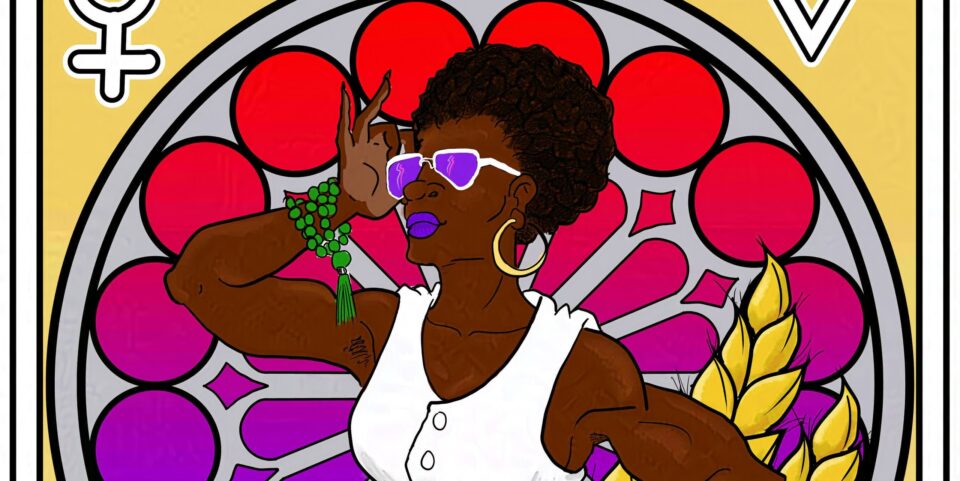
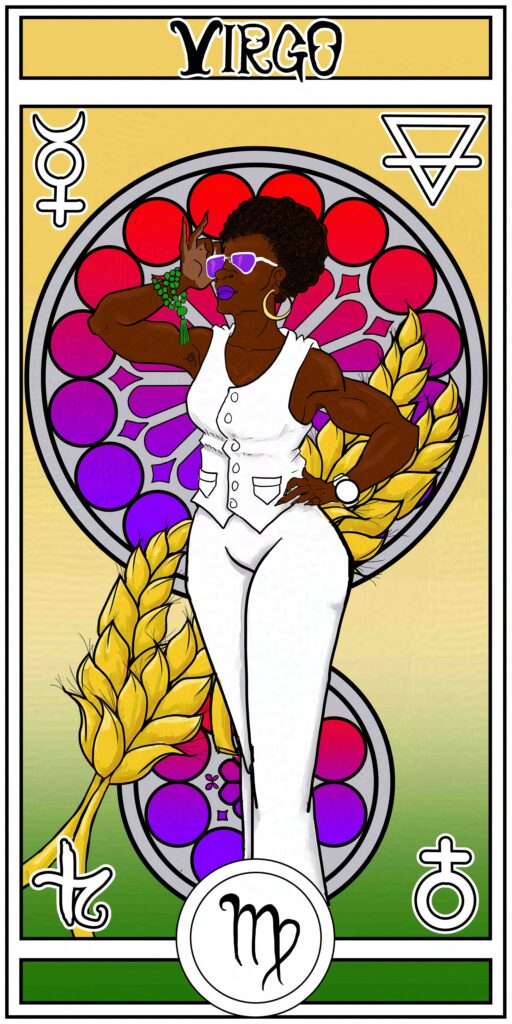
Huzzah! Behold, Virgo, my third Pop Culture Zodiac icon.
VIRGO (Aug23 – Sept22) Domicile and Exaltation of Mercury Detriment of Jupiter Fall of Venus Element: Earth Mode: Mutable
It took me a while to choose an image for Virgo; as I’ve joked several times before, there are many many many kinds of women. I’m sure you all know that “virgo” is just Latin for “girl”, with strong connotations of young and unmarried that get pretty skeezy if you over emphasize them here in the 21st Century. So, when this image came to me, I just ran with it.
The pose took me two tries to nail down in a way that satisfied me: those elbows and shoulders are more technically difficult than they may look. I kinda wish I’d spent more time looking for a pose reference, but I’d already spent nearly two weeks just pondering and was more than ready to put pencil to paper.
The stained glass windows came out wildly different to what I originally imagined, but also vastly different to what I thought I could pull off. I absolutely abused the shit out of the symmetry and gradient tools to make them, and probably half again as many layers as were strictly necessary.
The sheaves of wheat were a very last-minute addition to the sketch and almost didn’t make it into the final image. I had a vague memory of the wheat, and I did find it in a LOT of other Virgo images on the internet, but I couldn’t find any particularly reliable-looking explanations for its association with the sun-sign. Ultimately, I decided to keep it: however ill-explained, the wheat motif definitely goes back long enough to be legit for the purposes of this visually-oriented project, and the diagonal splash of constrasting color does a LOT for the image.
I hope you all like this image as much as I do. While relatively simple in a lot of ways, it was technically and creatively challenging in ways Leo and Cancer weren’t. October’s sign, Libra, is going to be similarly difficult: a dude holding scales gives me a little more specific direction, but not a lot. It’s also going to be potentially challenging as the first sign I’ll be illustrating in which I have significant placements.
Under the constellation of Pleiades, they made the image of a little Virgin, or the Figure of a Lamp; its reported to increase the light of the eyes, to assemble Spirits, to raise Winds, to reveal secret and hidden things. – Henry Cornelius Agrippa, Three Books of Occult Philosophy, Book II, Chapter XLVII (1)
The second Fixed Star in the lists I’ve found, and the second to receive full treatment in this series, is the constellation Pleiades, a cluster of six stars most famous for their near-universal recognition across times and cultures.
De Quindecim Stellis (2), a treatise on the fixed stars, describes the Pleiades as “of the nature of the Moon and the complexion of Mars”. This “nature and complexion” scheme is reported for each of the fixed stars, and if we’re being honest, I don’t know exactly what that is meant to mean. It also gives the stone of the Pleiades as “crystal” or “diadocos”, neither of which can be mistaken for clear identifications, and the herbs as fennel and frankincense. Other texts included in De Quindecim give quicksilver as the metal of the star, and suggest including it in talismanic rings.
Similar to, if not outright drawing on Agrippa, the lapidary Speculum Lapidum gives this image as, “A virgin or a young woman or a torch…” (3), and the Hebrew name of the constellation (at least, according to De Quindecim Stellis) is “the Lamp”, giving a strong through-line to the images.
Warnock reports that the Pleiades constellation, as marked by their brightest star, Acyone, is currently at 0 Gemini 14.
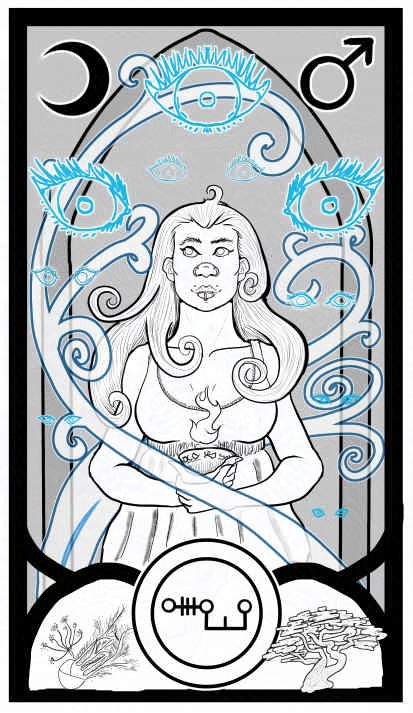
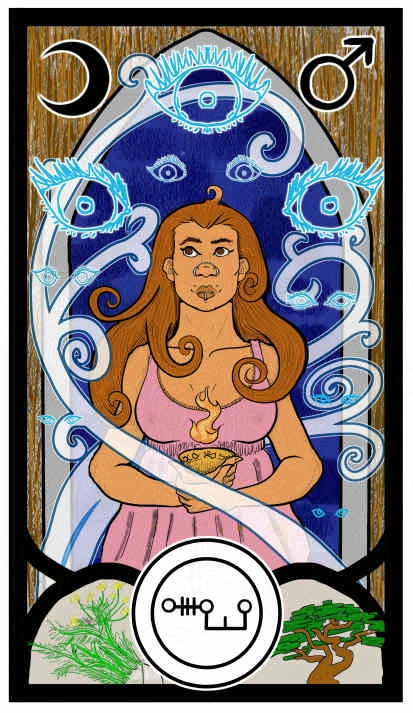
Nigel Jackson’s image in Warnock’s Fixed Star Magic (4) is a woman with a lamp beholding disembodied spirits and buffeted by winds. I chose a similar theme but wildly different visual composition: a portrait more suitable to a tarot-sized card in the Art Nouveau-inspired style and framing that I’ve been exploring over the last couple months, with seven sets of glowing spirit-eyes numbered for the Seven Sisters but not actually meant to represent them, and a spiral of winds around the central figure and her lamp. The bowl-shaped lamp is marked with the Agrippan Characters of the Moon. Yes, she has an Adam’s apple. Yes, that’s the now-slightly-dated trendy nose-ring chain.
Overall, I am exceptionally pleased with this image. I love her face. I love how the winds turned out. The eyes came out way better than I thought I could pull off. I think I did a fantastic job of a minimalist and suggestive background. I believe that she is having a mystical experience. And I think that the colors really work.
Admittedly, I am less happy with the fennel and frankincense at the bottom. Frankly, they were just much, much harder to draw than the hellebore and mugwort I did for Algol, even if I were more of a plant. This, of course, is why I drew the plants instead of the stones.
As you can see, I produced two versions: one mostly black and white with just a bit of color pop, meant to be easily printable for at-home use, and one full color, because this image really called for me to push myself.
For all that the Pleiades are held to be bad stars to be born under, and that fixed star elections are notoriously difficult to catch, I have found the spirits of these stars to be extremely amenable to sorcerous contact. I made my first such contact made during morning ritual with the aid of my Third Lunar Mansion talisman spirit (the 3rd LM is associated with the Pleiades), from which I got my first inkling of the image I would make, and a sense that a full-scale conjuration would be a good way to dial in both the art and the magic.
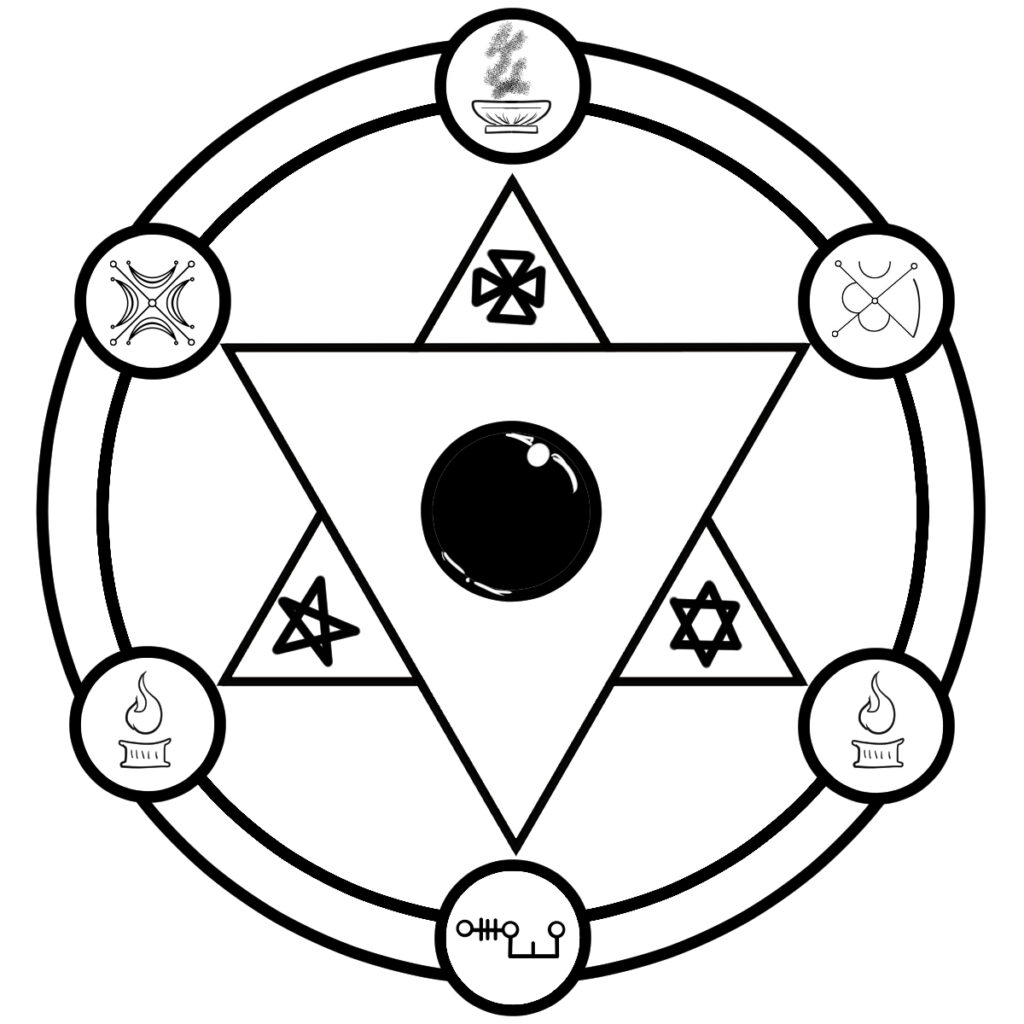
I made my second contact with the spirits of the Pleiades on the Day of the Moon during the hour of Mars, using the triangle of conjuration taught to me by Saturn (6) and a variation on the invocation in Warnock’s Fixed Star Magic, which combines a prayer written by Nigel Jackson with a PGM invocation. The spirits of the Pleiades approved the sketch i had done for my Image with a few editorial adjustments: more eyes, more winds. They also recommended that I substitute either archangel’s seals or the Picatrix planetary glyphs for the Agrippan Grand Planetary Seals that I used.
The spirits also told me to carry the Pleiades glyph that I had made for the conjuration ritual with me when I went to continue my work on the image. When I went to do so the next day, the paper lamen was hot to the touch, and my vision of the image stayed sharp and clear. In fact, it was a real struggle to put down my stylus and turn off the computer at the end of the day: I’d save the image, take one last look, and find myself tweaking some other little part.
Third contact was made on the Day of Mars during the Hour of the Moon, with the Grand Planetary Seals of the Moon and Mars switched out for seals of the archangels Gabriel and Sammael, as previously instructed. I had originally intended to repeat my Moon-day/Mars-hour invocation from the week before, but Monday … did not work out. Tuesday morning divination indicated that an additional conjuration/contact was unnecessary, but not unwanted.
The spirits came clearly and quickly. I asked to know them, and to be initiated into their mysteries, and they answered. The point of planetary seals was clarified somewhat: one should call them by the Lunar and Martial powers that one knows best, not by Gabriel and Sammael, in particular.
They confirmed, both explicitly and implicitly, that any combination of Lunar and Martial days and hours is a good time to conjure them. They told me to call on them under the waxing moon for their aid in seeing and commanding spirits of the upper air, and to call them under a waning moon for power over the dead, and to call upon them at any time for power over the winds: as messengers across the spirit world, and to raise and calm storms. They did not say, specifically, when to call them to clarify sight or to reveal hidden things; perhaps those are more closely associated with Pleiades talismans, only, but more likely they come with closer friendship.
They told me that rites of the Fixed Star Pleiades (with a bit of hopefully obvious modification) can be used to call up any of the sets of seven associated with the constellation, but that one must start from the beginning with each septet – that is to say, friendship with the daughters of Atlas and Pleione will win you no favors with the Babylonian MUL.MUL goddesses(5).
And they gave me this invocation to share with you:
I call upon you O Pleiades, you Seven Sisters: Alcyone, Maia, Electra, Taygete, Celaeno, Sterope, Merope. Under the auspices of the Moon [NN] and of Mars [NN], I call you. By Zizaubio, your messenger, I call you. Come to my circle. Shower me with your power, your spirit, your pneuma. Initiate me into your mysteries and [do the deed i wish].
Hail unto you, O Pleiades. Hail unto you Seven Sisters. Hail unto you, Alcyone, Maia, Electra, Taygete, Celaeno, Sterope, Merope. Daughters of gods, mothers of heroes, you who guard the gates of the ecliptic, I honor you. Initiate me into your mysteries and [do the deed i wish].
O you Pleiades, beautiful nymphs. O you mighty Seven Sisters. O Alcyone. O Maia. O Electra. O Tygete. O Celaeno. O Sterope. O Merope. I thank you for your presence in my circle. I thank you for the gifts of your mysteries. I thank you for your mighty deeds on my behalf, [the deed you wish]. As you came in power, go in peace with my gratitude.
Between the research – which I can hardly claim to have finished – the conjurations, and the illustrations, this image was significantly more work than the image of Algol. I had some concern that I would not be able to finish this post this month. I am both excited to continue to develop my relationship with the Pleiades, and extremely glad to be done with this image.
The next in the series will be Aldebaran, which comes third in those lists where he doesn’t trade places with Algol for first. I’ve done an Aldebaran image before, but I can’t recall that I’ve ever caught a proper election, which means that I will have a lot less previous relationship to draw on as I start my new illustration and do my conjuring. Still, I’m really looking forward to it, and I hope that you are, as well.
2 – De Quindecim Stellis: The Comprehensive Translations of Hermes on the Fifteen Fixed Stars. 2022. Various authors. Translated by Regulus Hess, edited by Christopher Warnock. This book also includes excerpts from several other texts, including the Speculum Lapidum.
3 – Leonardi, Camillo. Speculum Lapidum. Pennyslvania State University Press. 2023. Translated by Liliana Leopardi. (Hess and Warnock render this “A virgin or maiden, or a torch” in their excerpt in De Quindecim Stellis.)
Behold, friends! The second image in my new series of Pop Culture Zodiac icons!
LEO (Jul 23 – Aug 22) Domicile of the Sun Detriment of Saturn Element: Fire Mode: Fixed
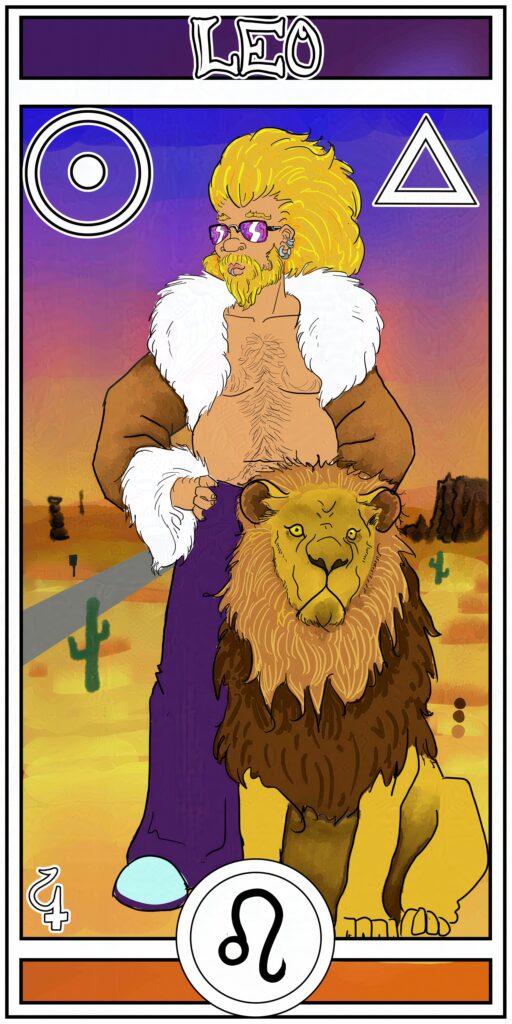
I already had the mental image for this piece by the time I was done with Cancer, which made this really easy to start. Perhaps unsurprisingly, I had originally planned for Leo to be sculpted-buff with a glistening sixpack and cumgutters. I’m glad I changed my mind, though, because I think fat and hot with 80s hair works even better for Leo.
As happy as I am with the figures of Leo and his lion, I’m even more pleased with how the background came together. Neither backgrounds nor colors are my strongest suit as an artist, and I approached this from a more painterly (albeit distinctly digital) direction than I have my previous attempts.
The background is composed of four layers: the sky, the ground, the “details” (signpost, road, and cactuses), and an underlayer. The underlayer wasn’t really planned. The transparency that helped the colors of the backgrounds blend also desaturated them, and the particular pen tool I used left some artifacts that I wasn’t quite pleased with. So I decided to see if a gradient underlayer would pull it all together. And boy howdy, did it ever. The plan was actually for the gradient to only go under the central box, but it was my first time using the gradient tool in ClipStudio so I screwed it up a little and the gradient ran the whole height of the image. But that turned out to be, in the immortal words of Bob Ross, “a happy little accident”, because the background now looks incredible and the purple bar at the top and the orange bar at the bottom fucking pop in ways I did not plan.
Yes, Macklemore’s Thrift Shop was playing in my head as I drew and colored this.
Inevitably, I’m tempted to begin waxing verbose on the nature of Solar Leo, but this is a fully visual project. More to the point, the project is (as I described it to my partner) capital-b Basic, and digging into the actual astrology any further than noting the elemental nature and planetary dignities is well beyond that scope.
The next image, Virgo, presents the problem of having too many options. There are, after all, many many kinds of women.
Behold! Medusa as the image of Algol, the first or third (depending on the list you’re looking at) of what are often called the Behenian Fixed Stars.
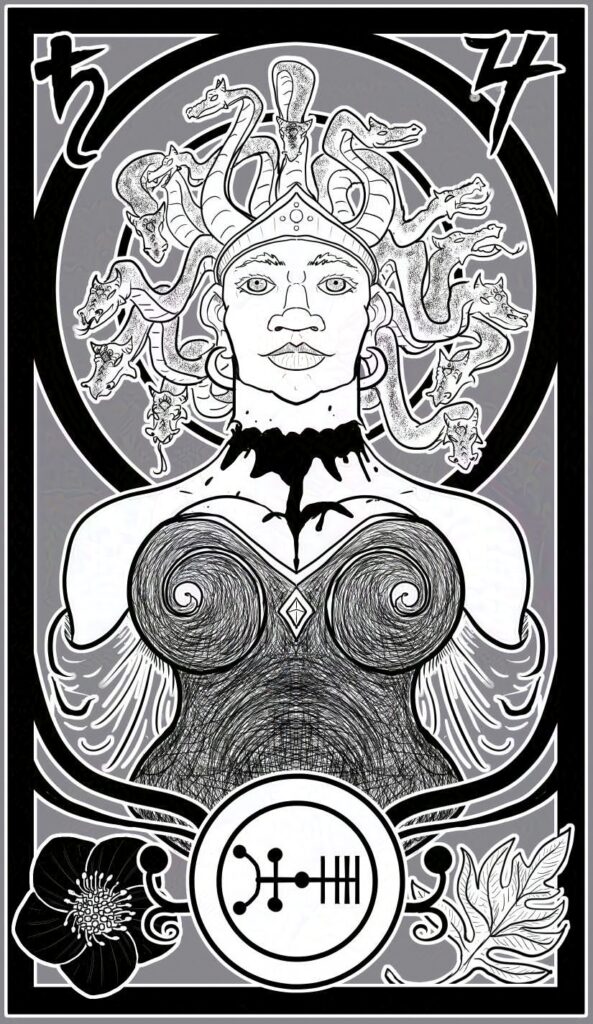
This image began as an excuse to draw a gorgon, and as a part of my recent re-obsession with Art Nouveau. I drew the initial sketch for it not long after doing the pencils for what became my Pop Zodiac Cancer image, and I think the image-to-image growth is pretty impressive. The thirteen dragon-headed serpents that comprise her hair are inspired by the dragonlike serpents in a number of Alphonse Mucha’s pieces.
I have depicted her saint-like, both bearing the wound of her martyrdom and standing whole and clear-eyed before the viewer, like Bartholomew draped in his own flayed skin. The Saturn and Jupiter glyphs at the top come from Algol’s associations with that planet; likewise the images of black hellebore and mugwort at the bottom. At the bottom is her sigil as it appears in Agrippa.
The fixed star Algol can be found in the Perseus constellation, and is closely associated with the severed head of Medusa. I’m struggling to find a concise and relevant primary source to cite for that, but it’s pretty widely attested, as is the fact that the Romans specifically called the constellation “Perseus and Medusa’s Head”, and I have finally tracked down Ptolemy’s Tetrabiblos to find where he describes the Gorgon / Caput Medusae in terms fairly similar to how later authors would go on to describe Ras al-Ghoul / Caput Algol (1). The connection is also easy to intuit: a monstrous star called the Demon’s Head, whose image is a severed head and is used to make powerful protection talismans.
Public Domain Image of the Constellation
My own elected Algol talisman was made with my gorgoneion pendant, with a rough black diamond cast in place in her forehead and the sigil of Algol inscribed in the back. She has been a powerful protector and a strong ally, and was the one protective talisman I took on my journey out West last year. (I had a couple moments where I had to reassure local spirits that she was there with me to finish trouble, not start it, and I suspect that had I carried a less potent or less monstrous protective talisman, I might have had more or at least different spiritual experiences on that trip.)
(Stock photo, not my actual talisman.)
The star, as I noted above, is closely associated with the planets Jupiter and Saturn, which are quite well placed in my chart, and its beneficial and protective properties are associated with the Moon, with whom I am quite good friends, so it’s unsurprising that I have had relatively uncomplicated success with this potent and ambivalent asterism. (The amount of devotional and otherwise flattering art I’ve done of Medusa and other gorgons over my lifetime certainly hasn’t hurt, either.)
In redoing my Algo research for this image and post, I have been reminded that protection is not the only magic to be drawn from Algol. Agrippa reports thtat, “it bestoweth good success to petitions, and maketh him who carry it bold and magnanimous…” in addition to keeping the body sound, protecting from malefic magic, and turning one’s enemies works against them (2). I need to sit with my talisman and negotiate some more of that action for myself.
It is also from Agrippa that I got the image of Algol as “a man with a bloody neck” (ibid). Other sources, tracked down just for this post, specify a bearded man (3), which honestly reinforces the gorgon connection for me, given that Attic and Archaic gorgoneions often depicted Medusa’s head as bearded as well as tusked and serpent-tressed (4):
Bearded Gorgon Image
Agrippa and the various authors collected in Regulus Hess’ De Quindecim Stellis: The Comprehensive Translations of Hermes on the Fifteen Fixed Stars attribute dual Saturnine and Jovial natures to Algol, and say that her talismans are most beneficial when she is conjunct the moon and either the ascendant or the midheaven, particularly when aspecting Venus or Jupiter, and her effects as particularly baleful when aspecting Mars. Christopher Warnock reports her current position as 26 Taurus 24.
Looking to work with this astral power, then, one best does so under the auspices of Saturn, Jupiter, and the Moon. Lacking a conventional astrological election — or preferring a more freeform witchcraft or Chaos Magick approach — I would consider a day of Saturn and hour of Jupiter approaching or at the Full of the Moon, burning mugwort to suffumigate your image and displaying (but NOT burning the extremely toxic) black hellebore . Based on my own experiences, I recommend invoking all three attested gorgons: Medusa, obviously, but also her immortal sisters Euryale and Sthenno. The patronage of Hekate will also serve you well, here, and my gorgoneion, at least, enjoys suffumigations of frankincense and myrrh.
Initially drawn as part of my Art Nouveau study, this image also represents a sooner-than-planned return to serious occult art, and the beginning of a concerted study of the fixed stars and the powers that move through them. I hope to do one of these images and posts each month, but I anticipate some images taking longer than others, particularly if I manage to catch an election or make significant first contact in some other way. With Algol appearing first on some lists and third on others, it is possible that I will come back to her in just a couple months.
1 – If the Sun be found with the Gorgon’s head (Caput Medusæ), and not aspected by any benefic star, and if there be no benefic present in the eighth house, and the lord of the conditionary luminary be opposed to Mars, or in quartile to him, the native will be beheaded. If the luminary culminate, his body will be maimed or mangled; and if the aspect in quartile be from Gemini or Pisces, his hands and feet will be amputated. (Aphorism LXXIII from the version hosted on Project Gutenberg, with apologies to everyone that I can’t hammer out a better citation right now.) And also, in Bk IX.
2 – Henry Cornelius Agrippa, Three Books of Occult Philosophy, Book II, Chapter XLVII, Paragraph 1. (You’ll want to wordsearch “algol”; sorry i can’t make a direct link.)
3 – A number of such descriptions can be found in Regulus Hess’ De Quindecim Stellis: The Comprehensive Translations of Hermes on the Fifteen Fixed Stars, as presented by Christopher Warnock. The text collects excerpts from a number of texts, including Agrippa, detailing the attributes, images, and uses of the Behenian Fixed Stars.
4 – I’m going to send you to Wikipedia for this fact that I have both personally observed and seen stated in more scholarly contexts.
Like so many of us, my earliest forays into the occult involved pop culture sun-sign astrology. For me, personally, that always involved the accompanying art: posters and icons and illustrations depicting the constellations and combinations of anthropomorphic and theriomorphic images. Crabs and/or beautiful women for Cancer, bowmen and/or centaurs for Sagitarious, and all the others. As my studies in astrology — both natal and talismanic — have progressed, I’ve developed something of an ambivalent relationship with sun-sign astrology, which is so often shallow and inaccurate even by its own measures, and sometimes seems to reject the larger astrological tradition from which it grew (also a common experience, I imagine). Even so, I’ve long imagined my own potential contributions to that genre.
Perhaps inevitably, most of my imagining revolved around Scorpio, where my own natal Sun and Moon reside. And I did consider starting there. But then I’d need to figure out what order to do the rest of the series in. So, instead, I looked to the placement of the sun: the sign Cancer, at the time I did the first sketch, and for just a few more hours by the time I finished this version.
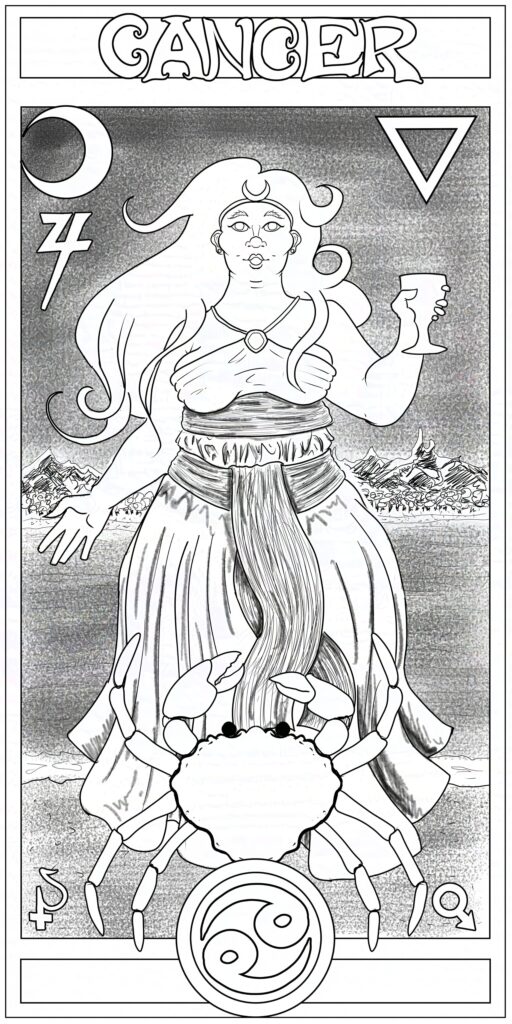
So here is a poster depicting Cancer as I perceive her, with some obvious nods to her traditional attributes.
CANCER (Jun 21 – Jul 22) Domicile of the Moon Exaltation of Jupiter Detriment of Saturn Fall of Mars Element: Water Mode: Cardinal
As the first in a series, I am inevitably not quite satisfied with it. The Art Nouveau elements (because this began and will continue as a part of my belated study in Art Nouveau composition and design), while intelligible, are understated. Aspects of the layout that worked in pencil did not translate well to digital inks. I’m not sure that black and white is actually the direction I want to go with this series. If I had a few more days of sun-in-cancer, I would try my hand at some colors, and add some Cancer-aligned flowers and/or gemstones to the bars at the top and the bottom. I didn’t leave myself a place to put the dates associated with the sun sign. And I have simply no idea how to visually convey fixed/mutable/cardinal mode.
At the same time, though, I think that this marks a good start to both the pop zodiac images and my study of Art Nouveau imagery. The faux-charcoal and faux-pastel textures I used for the water and the night sky in the background and the sand in the foreground, and the textured lines I used for the mountains and the forest on the far shore, all worked well enough. I like her face, and her hair, and her robes. The crab had no business turning out that good.
Now that the Sun has crossed into Leo, I’ll start the pencils for that sun-sign. I already have a pretty solid vision of what I want to draw for that, and Virgo is almost painfully easy to imagine, so you can look forward to this series continuing at least for a few months. I think that we’ll all have a lot of fun with this.
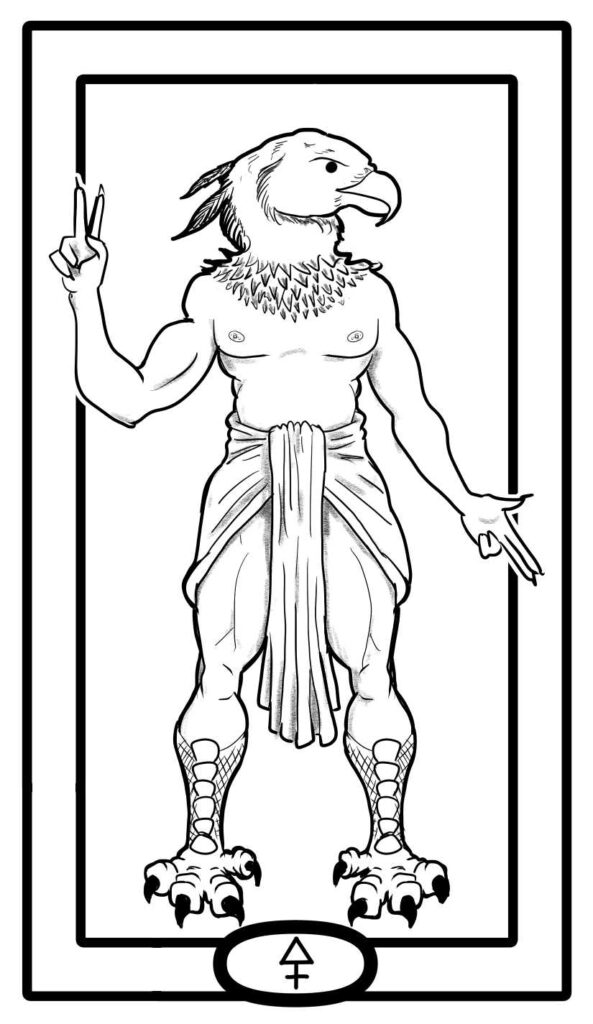
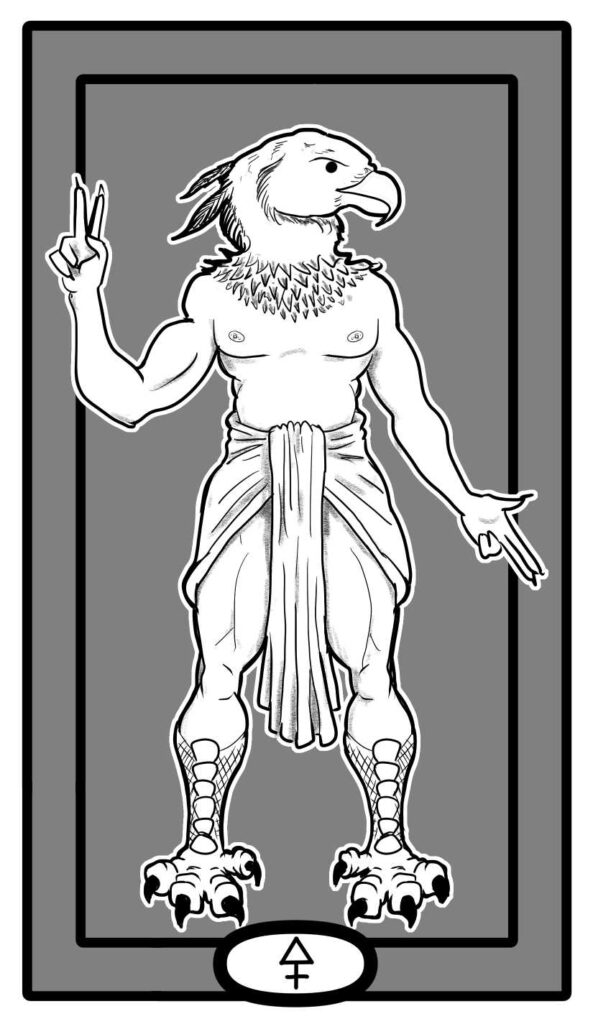
The image of Venus, according to the opinion of the wise Mercurius, is a shape with the body of a man, the face and head of a bird, and the feet of an eagle. This is its shape.
Picatrix, Bk II, Ch 10, Para 28, trans. Attrell and Porreca
Behold the Image of Venus According to Mercurius!
My first try at this image had a very different head: dove-like, like my Image of Venus to be Well Received and Esteemed by All, but facing the viewer. Technically, it was well-executed, but I fucking hated it. When I vented my frustration about it over on bsky, Fae Grigoryeva suggested a harpy eagle and shared a fantastic photo reference, which – as you can see – was absolutely perfect. I considered going back and seeing if I could find a reference for harpy eagle claws, specifically, but decided against because I like the claws as I drew them, already.
I struggled with what to do with his hands. As you can see, I ultimately went with Baphomet’s gesture of benediction.
I considered making him explicitly trans, naked and with top surgery scars, but in this case decided to make it more ambiguous, just leaving his wasp waist and mighty thighs. I dressed him in a fantasy loincloth with some of the same geometry as the Egyptian kilt I dressed the Image of Saturn in mostly because I just really like that shape.
It’s interesting to me that this image is so similar to the Image of Venus to Be Well Received and Esteemed by All, a bird-headed woman holding the same comb and apple as the Image of Venus According to Picatrix, which is why I originally tried to give him a similar dovelike head. I suspect there’s something interesting to sus out there, but I’m just going to run with “Venus is genderqueer” and leave it there, for now.
This image completes my collection of images according to Mercurius, my second complete set of Picatrix planetary images. It is my seventeenth Picatrix planetary image, altogether. Some day, I may come back and do the rest of the images “according to Picatrix” (I’ve already done Venus, Jupiter, and Saturn), or some of the other authors, but – somewhat to my own surprise – I’m a little tired of the planets and of the Picatrix. I don’t know, yet, where exactly I’m going to turn to next for inspiration. I have a few thoughts, but I want to reflect on this collection a bit before I chose my path forward.
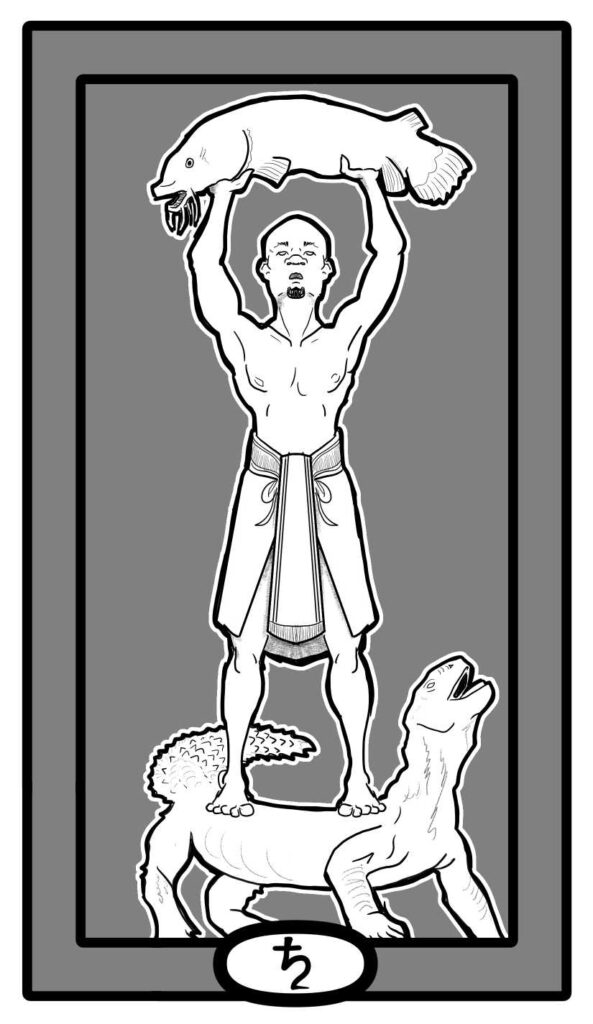
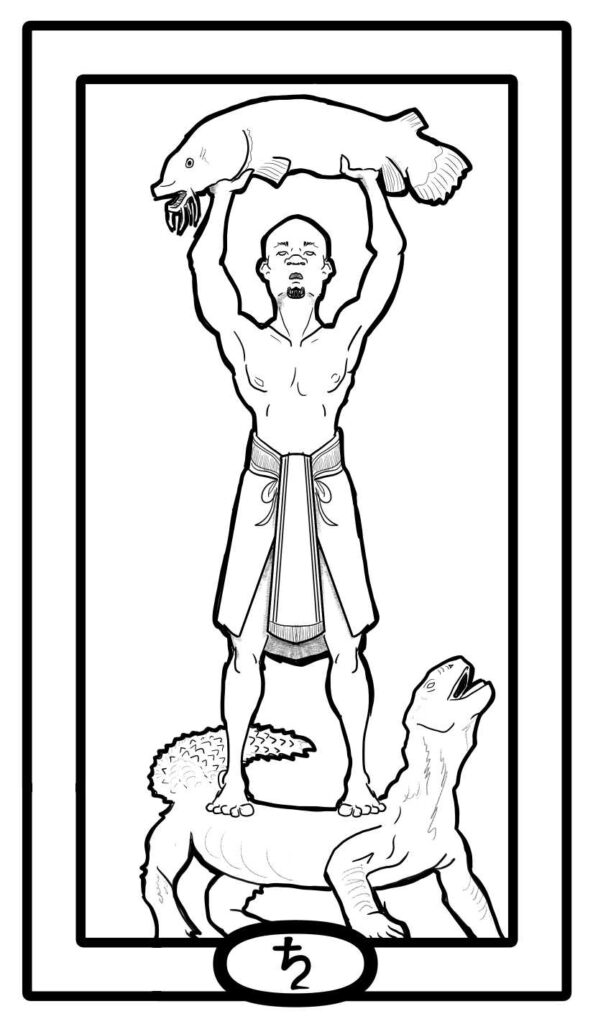
The image of Saturn, according to the opinion of wise Mercurius, is the shape of a man standing, raisihing his hands above his head and holding a fish in them. Below his feet is a lizard.
Picatrix, Bk II, Ch 10, Para 13, trans. Attrell and Porreca
Behold, my penultimate (for now) Picatrix planetary image, Saturn according to Mercurius!
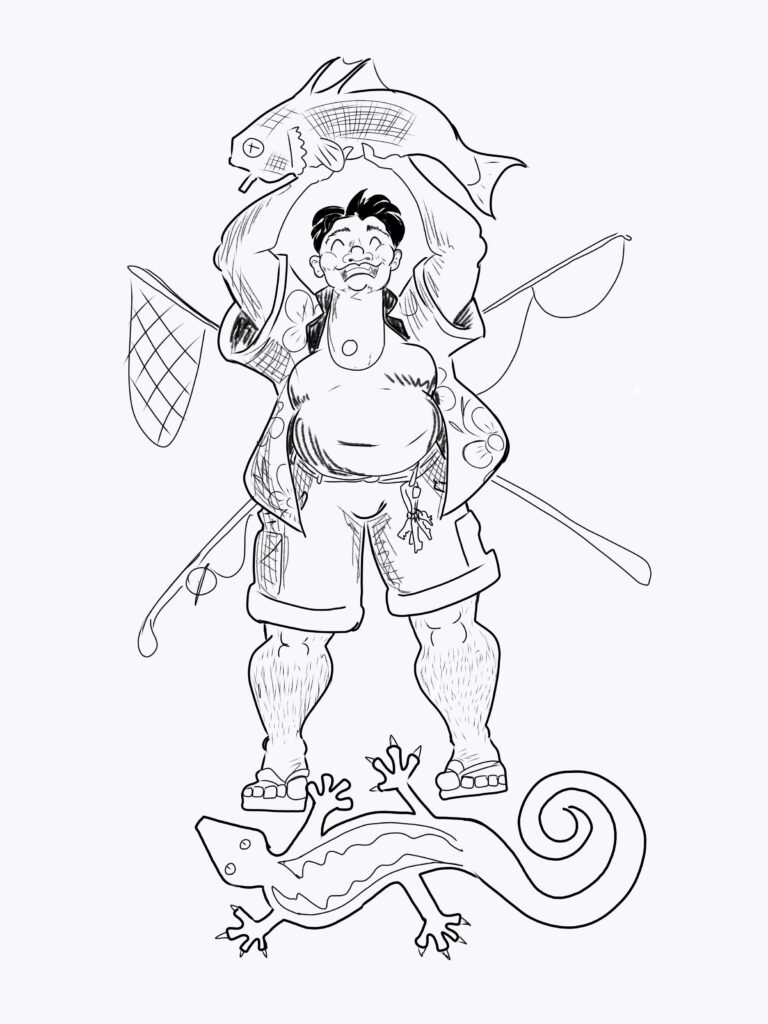
This one was a challenge because the image this description first conjured for me was more comical than I think most people are prepared to accept from/of Saturn: a fat butch showing off her catch like she’s making an OKCupid profile, standing over the Sobe lizard:
Gods, that was so much fun to draw. More than a month later, this one still makes me giggle, and getting past it to a more conventional image of Saturn was hard work.
In the end, though, I think I succeeded.
I can’t say why I decided that this Saturn should be dressed in an ancient Egyptian kilt, but I think it works well. That Egyptian theme helped me choose what sort of fish and lizard to draw with him: an electric Nile catfish and an Egyptian spiny-tailed lizard. The fish is admittedly so-so, but the lizard and its dramatic pose (copied from the fantastic reference photo I found) more than make up the difference.
As always, you can find high resolution versions of these images over on my Patreon, where you can also find a lot of my art and writing that never makes it to the wider web.
Behold, my latest Picatrix planetary image, Mars according to Mercurius!
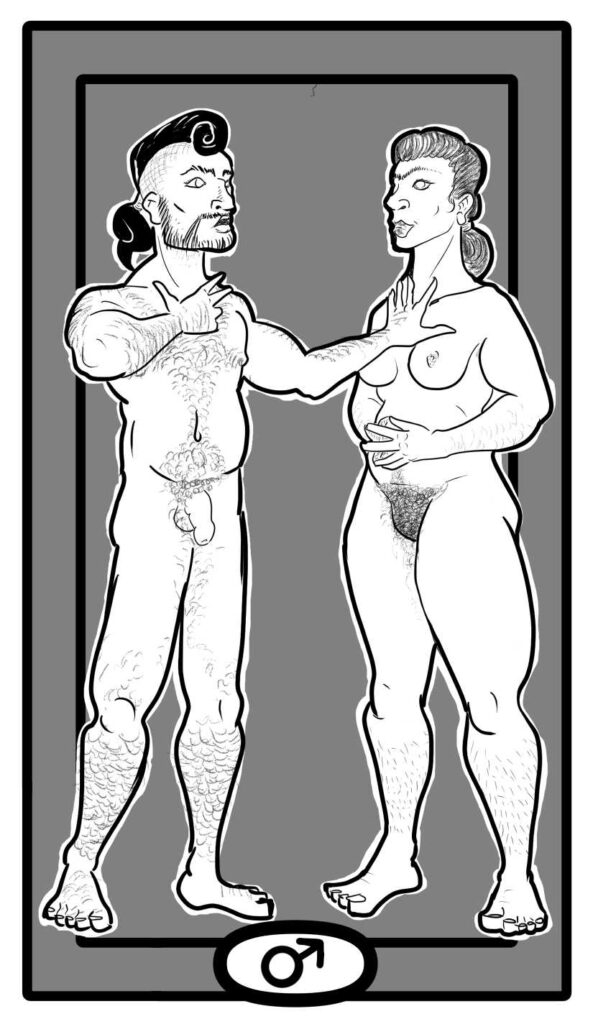
The image of Mars according to the opinion of Mercurius, is the shape of a man standing erect on his feet, holding on his right a beautiful virgin standing on her feet, which is an image of Venus with her hair fastened back. Mars is placing his right hand on his own neck and his left hand extending above her chest; he is facing her and admiring her. – Picatrix, Bk II, Ch 10, Para 20, trans. Attrell and Porreca
This image is interesting (and a technical challenge) first and foremost because it features not one figure but two: Mars, here, is accompanied by Venus, and they are very explicitly interacting. I may be missing something, but as far as I can tell the only other mutltiple-(human-)figure image is Venus According to Ptolemy as translated by Greer and Warnock: “a nude woman with a chain around her neck held by the image of Mars who stands before her” (Picatrix Book II, Chapter 10, p. 104 of the Liber Astratus edition), though it’s worth noting that Attrell and Porreca render that line as “in front of her neck she has the shape of Mars with a single chain” (Bk II, Ch10, Para 29 of their translation), in which case “the shape of Mars” could easily be understood as a man holding a chain, a man who is chained, or a big ol’ glyph of Mars around her neck like she robbed some macho man from the 1980s. (If I do ever come back to the Picatrix planets as an artistic subject, Venus According to Ptolemy is a strong candidate; in this moment I’m juggling two possible versions: a muscle mommy Venus wearing a glyph of Mars on a heavy chain and a high femme Venus holding Mars in chains.)
It also presented an interesting design challenge in that while the man is described as naked, the image of Venus is neither given a costume nor explicitly also nude. I think I was unconsciously recalling that Greer-Warnock rendering of the image of Venus when I decided to make them both naked. Having realized that as I write this, I have taken a moment to reconsider that decision, but I think it’s the right call because of how “naked man/dressed woman” hits on the internet in this year 2026 of our Demiurge. (And, of course, because I just like making art with naked people.)
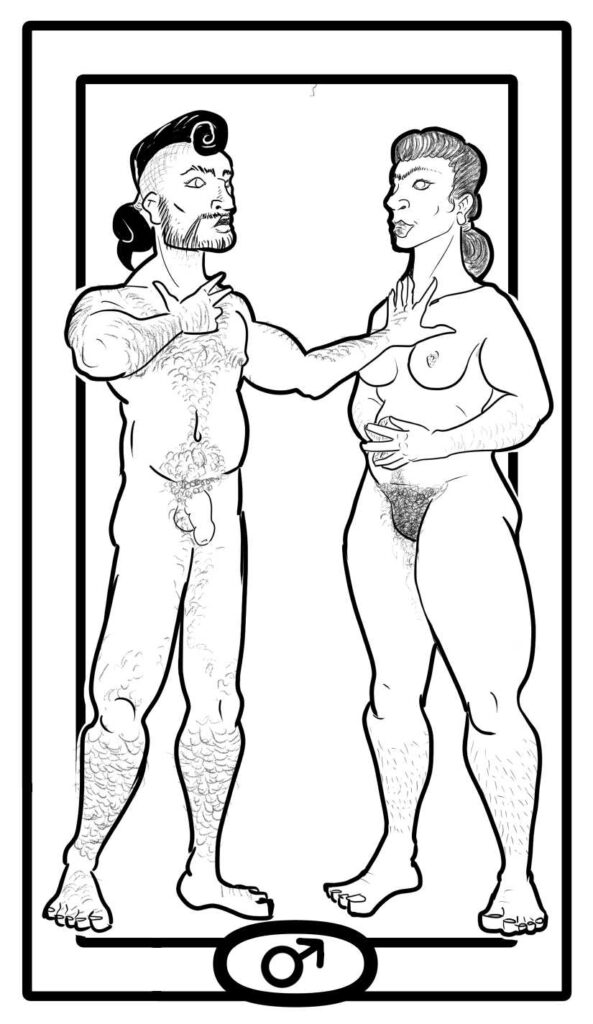
Inevitably, there’s some very tiny technical things that vex me. There’s still something just a hair off about their respective proportions (though, of course, humans aren’t actually any one set of idealized proportions: we come in all shapes and sizes, which is something that I have tried to showcase in my collection of images.) Flaccid penises always look silly, no matter how big, small, or average they are. There’s also a few thematic elements that I’m still trying to figure out: do I want that white outline around them? I’ve added it to some and not to others; I also haven’t gone about it quite the same way twice. Before I print them, I need to make an actual decision about that for the sake of consistency.
Over all, though, I’m very pleased with this image. I’m proud of the clean evolution from my first sketch, where I was figuring out the pose and how to interpret the texts, to the sketch I shared with you last week, to this final black line version. I feel like I’m fucking finally figuring out how to draw feet. I’m like the composition and how they interact with the frame. I like both their faces, but especially hers. I really like how the textures of their hair turned out. I think I did a particularly good job on the linework, especially the heavy border.
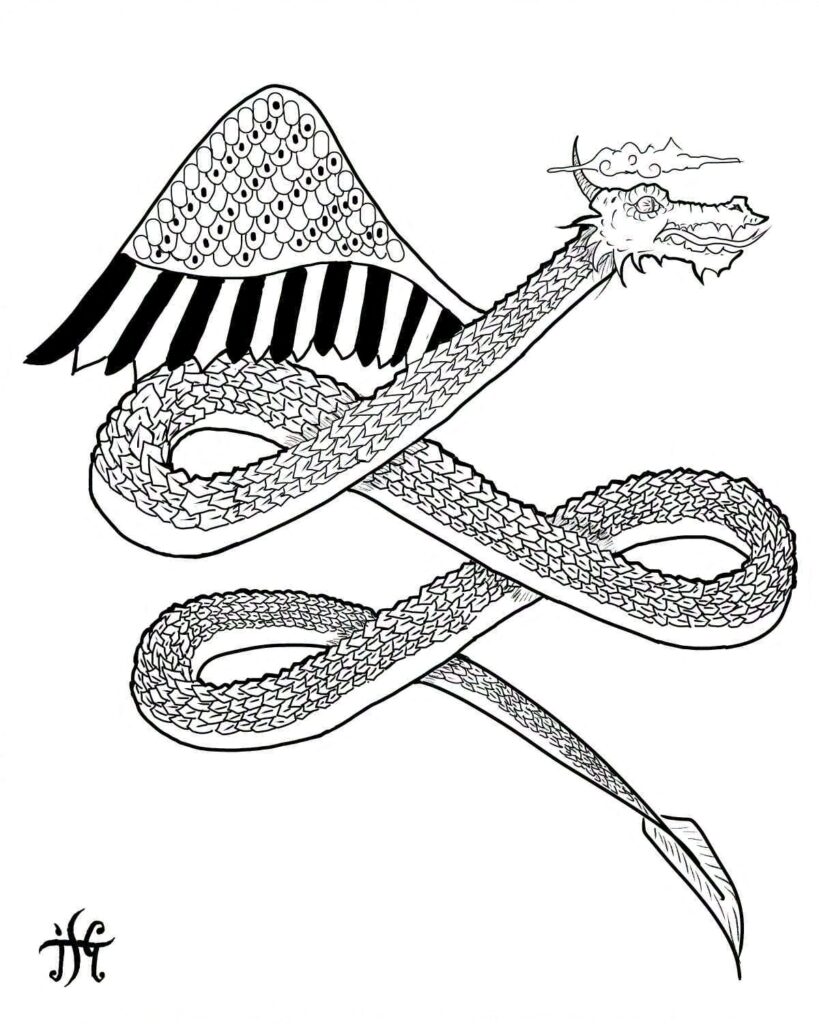
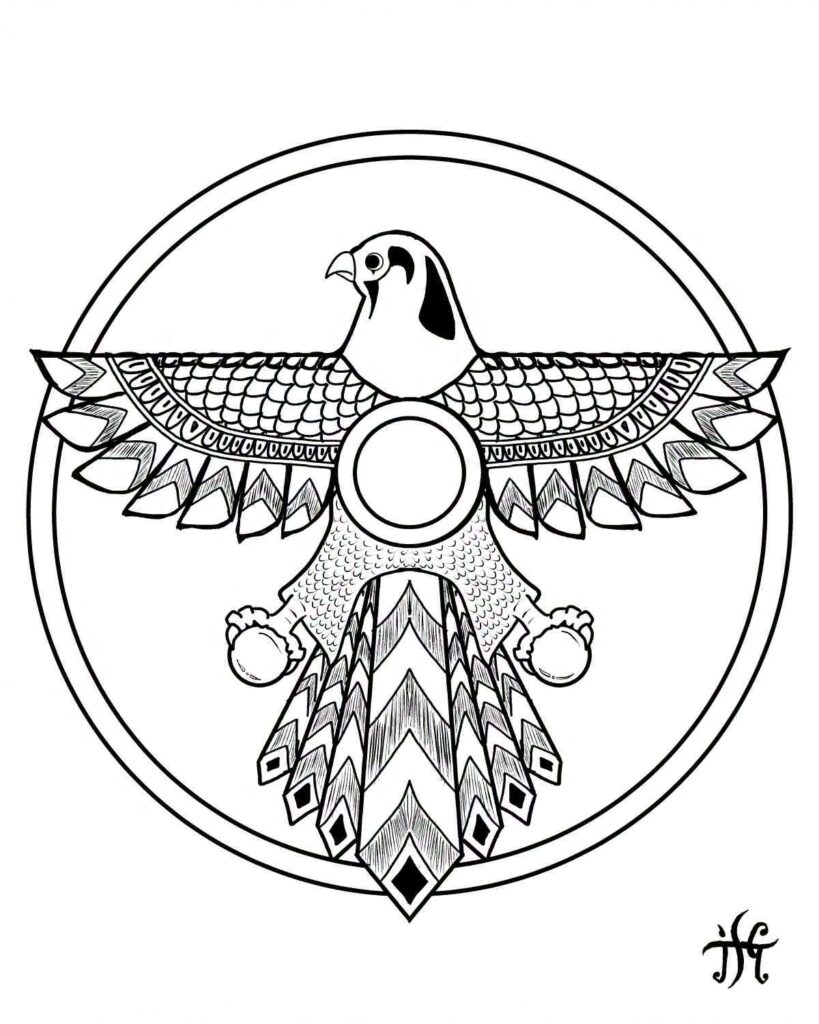
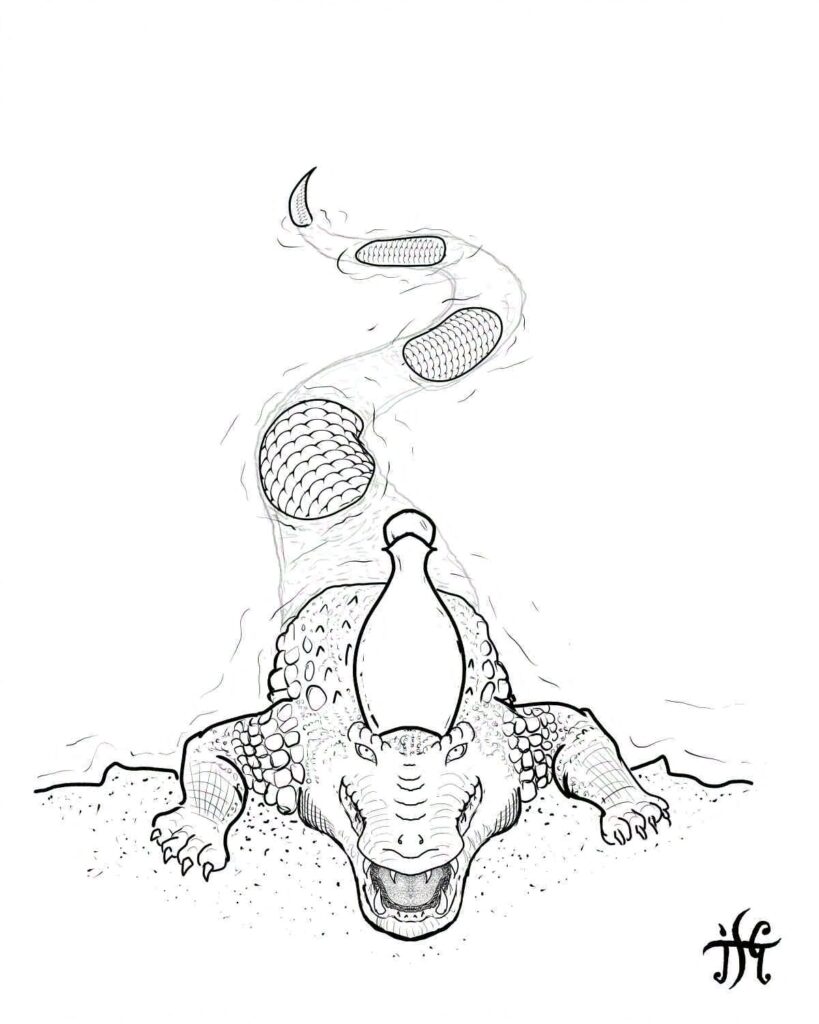
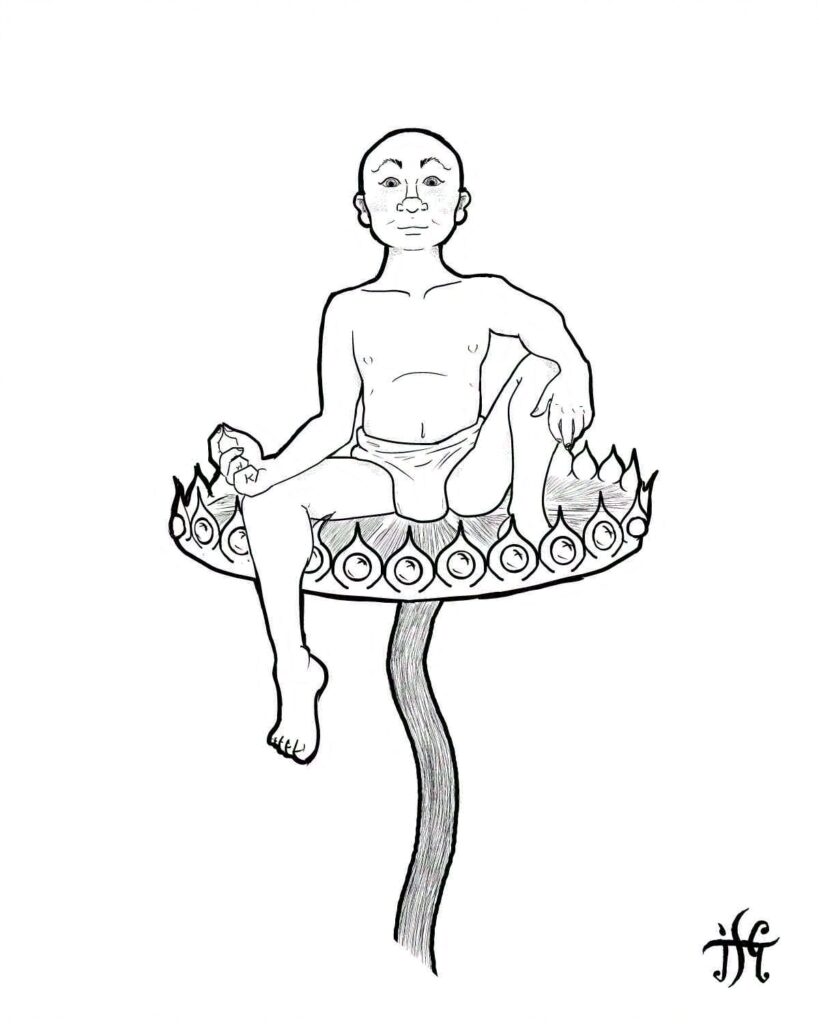
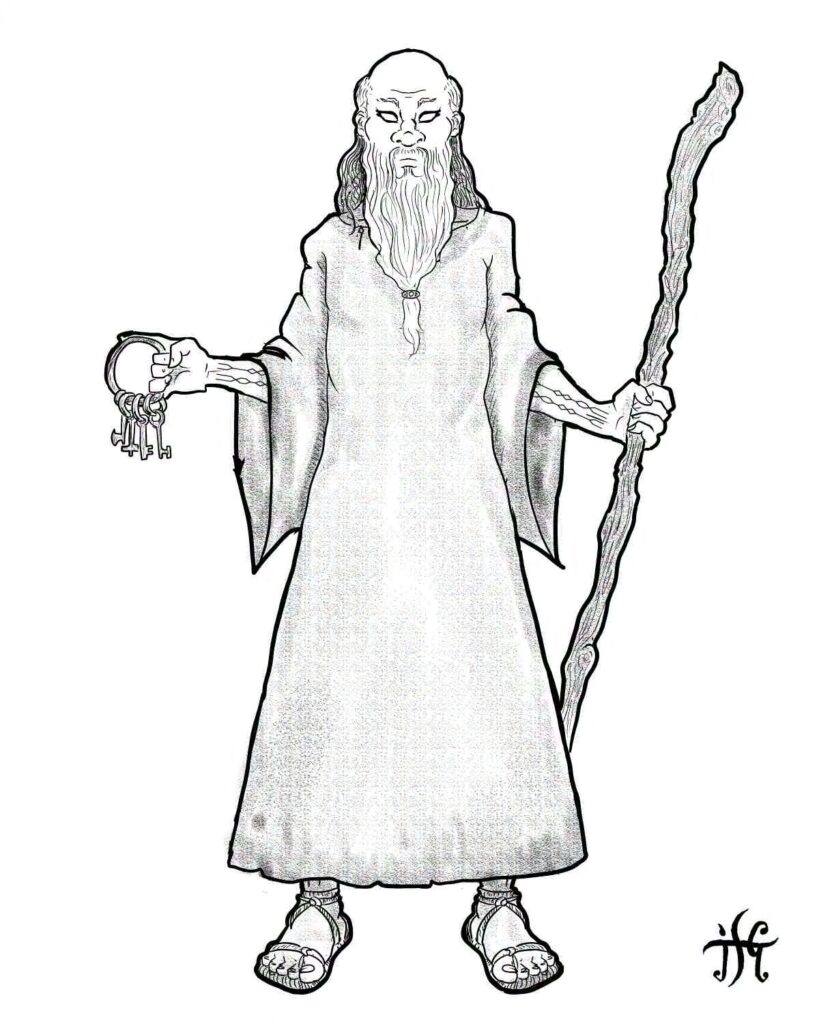
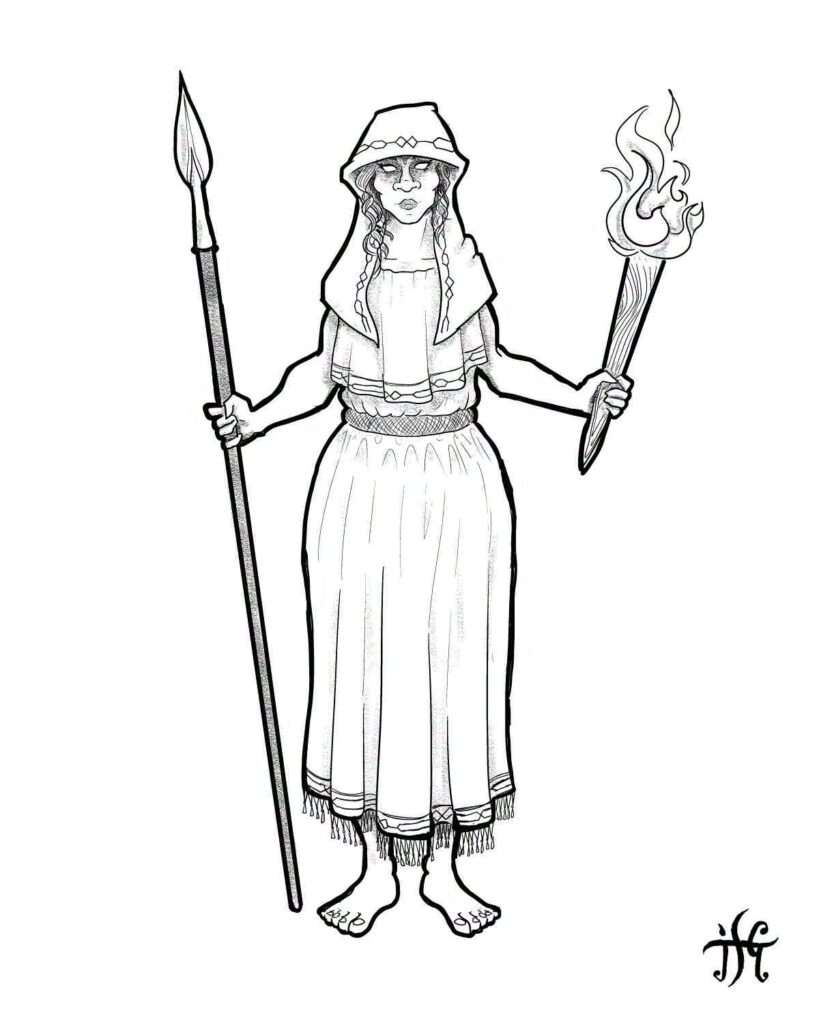
In May of last year, Polyphanes reached out to me about doing a series of illustrations for him: icons of six solar guardians that feature prominently in his personal practice.
I was, of course, delighted. I’ve only done a handful of commissioned illustrations, but I’ve always wanted to do more. And Polyphanes and I have admired eachother’s work since we were both in college. But it was also a large project, which I feared might be a bit past the edge of my expertise: six figures, three theriomorphic and three anthropoid, drawing on both Eastern and Western visual traditions. Real talk: the dragon and the wizards/priests were right up my alley, and i was excited for the challenge of the pseudo-Egyptian falcon, but the crocodile and the child fucking concerned me.
Working up a price estimate was its own challenge. I know how long making jewelry takes, and what to charge for that labor. The time it takes me to do an illustration is a lot less consistent, and this project included both revisions and publication rights, which I really didn’t know how to calculate. But I did ultimately put together a quote that we were both happy with, and if I did underestimate the labor … well, that’s just part of the learning process. When I said “give me six or eight weeks after I get back from my road trip”, Polyphanes laughed and said, “how about I give you until this time next year?” (He was absolutely right.)
Polyphanes, himself, has this to say about the project as a whole:
This project of the Guardians of the Directions of the Cosmos came about from my work with the PGM, extending certain aspects of it into a more cohesive and expansive approach. These spirits can be sourced at least in part from PGM II.64—183 and PGM.XII.14—95, but there’s a huge amount of own explorations of and experience of these spirits that went into my realization of them and their images. There are two groups of them, the four for the directions and the two for the heights and depths, each marking a particular motion or domain of the Sun. I call on them as part of my daily empowerment ritual, and I also make an offering to them in my seasonal rite for the Sun crossing the equinoxes or solstices. They take a role not unlike the Watchtowers in some forms of modern magical practice, but they have a distinctly solar presence for me where each intertwines with the other, not wholly joined but not wholly separate either. That I’ve been able to work with JS to bring form to these spirits as JS brings these spirits into the world has been nothing short of a privilege, and I am deeply grateful for all the work and diligence xie’s done.
Along with the descriptions of the images (much clearer than anything the Picatrix has given me), Polyphanes included a copy of his ritual document and some pictures of his altar, which I used to make initial contact with the spirits in question. I don’t know that I ever made particularly lasting contact with those spirits, but it was enough. Like other magical art projects, in particular, inspiration came in clear strong bursts, in between which were days, weeks, even months of inactivity. Throughout the whole process, I tried to keep in mind that these images were icons, portraits of spirits whose pleasure was as important as my mortal client’s.
I drew the dragon first, then the falcon, then the crocodile, then the child, then the wizard, and finally the priestess. I chose that order deliberately, working roughly from hardest to easiest. I draw a lot of dragons, but I knew from the beginning that I wanted to draw Every Single Scale, and I knew that was going to suck, and that he was going to be a struggle to fit onto the page. I had a similarly clear vision of the falcon, but knew that the strong geometry of the pseudo-Egyptian stylization was going to be a real challenge. The crocodile, somewhat outside my wheelhouse, was easier chiefly in that I thought the experience of the dragon and the availability of reference photos would smooth over some of the difficulties (though his scale texture proved one of the greatest challenges of the project). Similarly, the Buddha-like child was easier only in that he has a human form; this may literally be the first child I’ve ever drawn. Finally, I got to the wizard and the priestess: themes so deep into my comfort zone that I knew that, no matter how exhausted the other figures left me, I would be well equipped do to them justice even if I were skating in at the last possible minute.
All six images began as pencil sketches on drawing paper, which remains my strong preference even as continue to master (and learn to genuinely love) digital linework and start to really grasp digital colors. The linework was almost all done in Clip Studio Paint 2.0, first on my laptop and then on my desktop, using a Wacom Intuos S graphics tablet (yeah, one of the little ~6x8in ones), with a few sections of the falcon done on my low-end Samsung Galaxy tablet using the mobile version of Clip Studio. I tried sections of the dragon and the crocodile on the tablet, as well, but couldn’t get it to work the way I wanted.
Last week, when I finally set them all down side-by-side-by-side to see how they worked as a set (looking at them on the screen is not the same), I was genuinely stunned by how well the whole thing had come together despite being the work of an entire year. I love each and every one of them. I can’t pick a favorite. Each has some element that I think is spectacularly executed, and I think they serve their intended purpose(s) admirably. I think I did a great job on the dragon’s scales, and I love his face and his cloudy crown. I love the falcon so much that I want to make jewelry out of him. I am so pleased with the face of the crocodile, and how I was able to work the reference image into what I wanted using my knowledge of foreshortening and anatomy. I love the lotus that the youth is sitting on, and I think he looks fucking fantastic for being my first child ever. I love the textures I achieved on the old man’s robes and sandals. I love the woman’s headscarf and the shadows over her face and hair and the way her peplos came together.
Overall, working on the project was an absolute blast. I am honored to have been chosen for the project, and proud of myself for seeing it through despite being a bit outside my wheelhouse. I hope to have the opportunity to do more images like these: portraits of beloved gods and spirits for the magicians who conjure them, drawn not just from ancient texts but from their experiences of these powers.
Along with my Picatrix planetary images, and the illustrations for my novel, The Prince’s Fighters, these images have really pushed me to mature and grow as an artist. I’ve felt very stagnated as an illustrator for several years, now, and it feels really good to see and feel such clear improvement over the last twelve to eighteen months, especially while the final results remain so recognizably my own.
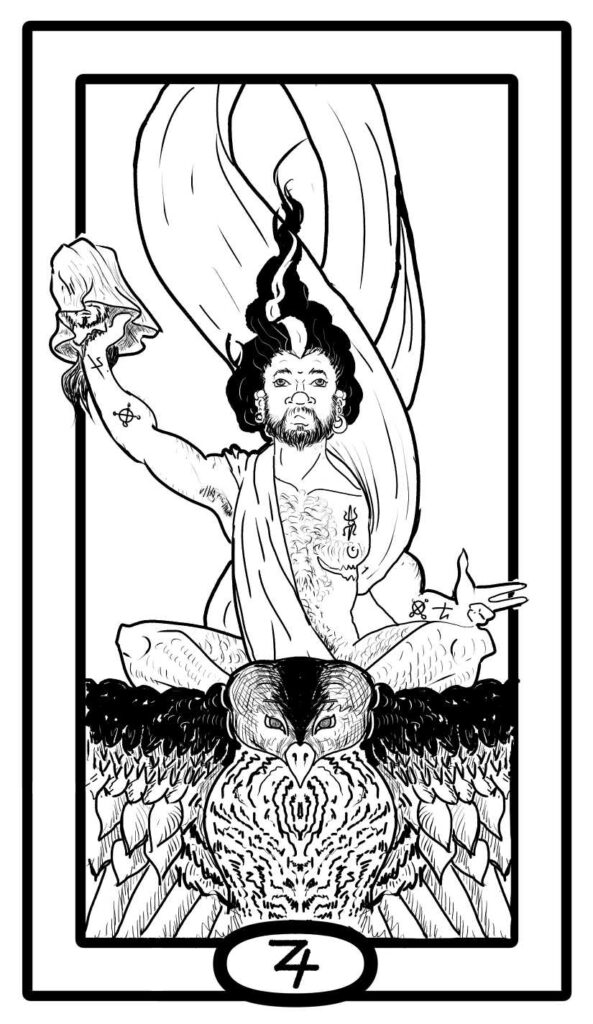
“The Image of Jupiter, according to the opinion of Apollonius, is the shape of a man sitting on an eagle, wrapped in a cloth, with his feet on the eagle’s back, and a head, covered by a cloth, held in this right hand. This is his shape.” -Picatrix Book II, Chapter 10, Paragraph 15 (Attrell and Porecca, 2019)
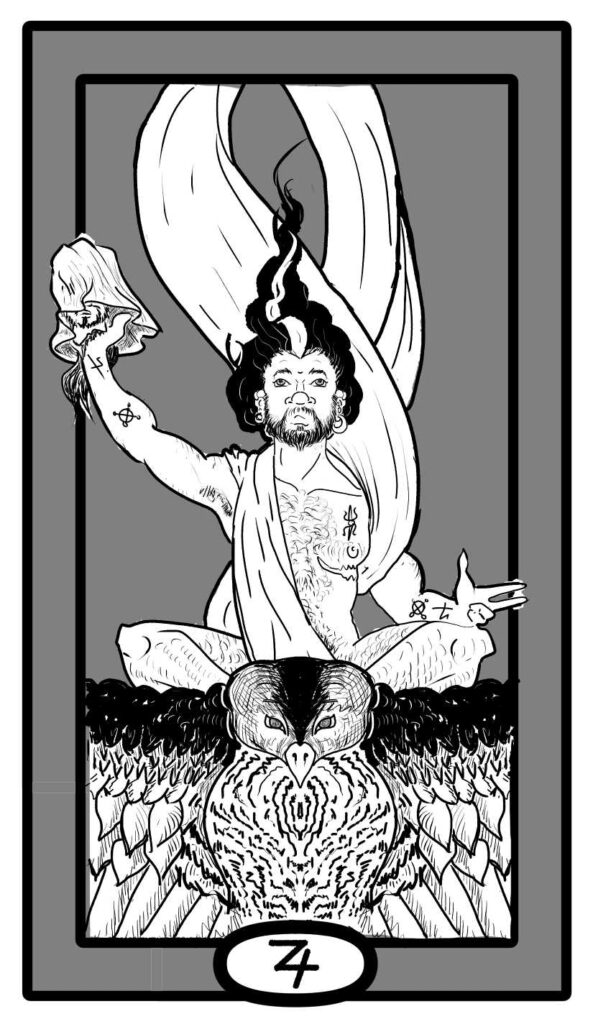
Behold, my latest Picatrix astrological image, Jupiter According to Apollonius”, my third Image of Jupiter following “… According to Picatrix” and “… Mercurius”.
The man and the eagle are obvious elements for an image of Jupiter. The head is less obvious. Having taken Gil the Dragon’s argument that the lion-headed image of Jupiter according to Picatrix is a callback to Herakles, similar lines of thought lead me to take the severed head here as a callback to Algol and Medusa, which would make this figure a rendition of Perseus.
As with all of these images, the vague description left me with a lot of room to make creative design decisions. I took “wrapped in a cloth” here the same way I did on my Mercurius image because it fit with the flying motif, because I like the continuity it adds between the two Jupiter images, and honestly because it’s just so much fun to draw. I chose to depict Jupiter as a hairy trans man with visible top surgery scars for mostly the same reasons I made the Mercurius image fat: because it’s fun, because it looks cool, and to add a bit more diversity to my imagery.
The eagle was a real technical challenge on account of I don’t have a lot of practice drawing birds. I based this one on a photo I found of a European imperial eagle in flight. The drawing is imperfect, but the fact of the matter is that real birds aren’t ever actually majestic, they’re all just that funny looking. And I’m proud of the feather patterns if not the degree to which it turned out more stylized than the figure.
The head he’s holding up, though, gave me a little bit of pause. From a design perspective, it was a challenge to navigate showing enough of the thing he’s holding under its cloth to be clear that it’s a head without reducing the cloth to the point where it looks like a doily hat. Plus the inevitable question of why the cloth isn’t blowing away in the wind that’s billowing Jupiter’s hair and the cloth he’s wearing. Ultimately, I went for intelligibility over realism, and I think that it looks pretty fucking good. Also, while I do think that I am persuaded by my own speculation that the severed head is supposed to be (or at least evoke) Algol/Medusa, I chose to render it as a bearded man’s head for the sake of intelligibility at the intended scale of print (tarot car size).
The completion of this Image of Jupiter marks the completion of my first full set of Picatrix images: all seven planets as described by Apollonius. I’ve been thinking about that fact all week as I’ve wound up to finishing the image and writing this post, but I think I have a bit of processing to do before I say more. Now, finally, what are the magical uses of this image?
Modern magicians emphasize the wealth and abundance aspects of Jupiter, and those are absolutely present in the Picatrix: “Entreat Jupiter for the accumulation of wealth…” (Book IV Chapter 4, Para 6) “Jupiter [is the substance of] the power of increase” (Book IV, Chapter 4, Para 55) More, though, the Picatrix speaks of Jupiter of the planet by which one extracts justice and favor from rulers, and for spiritual pursuits. Health (physical and mental) and safe travel also get honorable mentions. “… the benevolence of Jupiter is appropriate to the works of clergymen, kings, and lords” (Book 2 Chapter Three Para 5) “Jupiter is the source of growing power. He governs an aspect toward law, legality, jurisprudence, and the ease of acquiring requests, reparations, and restraints. He guards against mortal illness. He governs wisdom, philosophy, and the interpretation of dreams. … Among the crafts, he governs ruling, jurisprudence, and selling pristine merchandise.” (Book 3 Chapter 1 Para 4) “Jupiter is the author of life and the sciences. Laws, treaties, and judgements proceed from him.” (Book 3 Chapter 3 Para 33) “Entreat Jupiter for … the enhancement of dreams, the pleasure of escaping sadness, the leaving behind of toil and quarrel, and safe journeys by land or sea.” (Book 4 Chapter 4 Para 6)
#/media/File:Sidney_Hall_-_Urania's_Mirror_-_Perseus.jpg)