
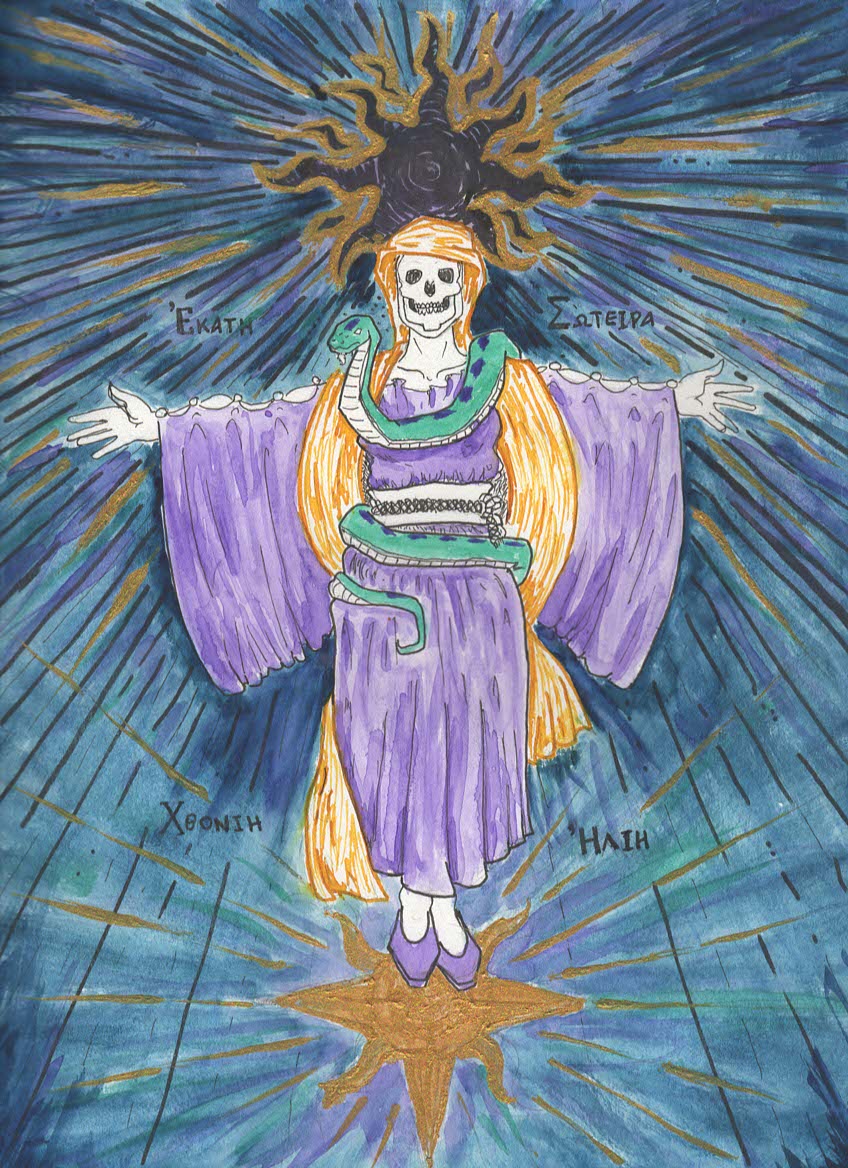
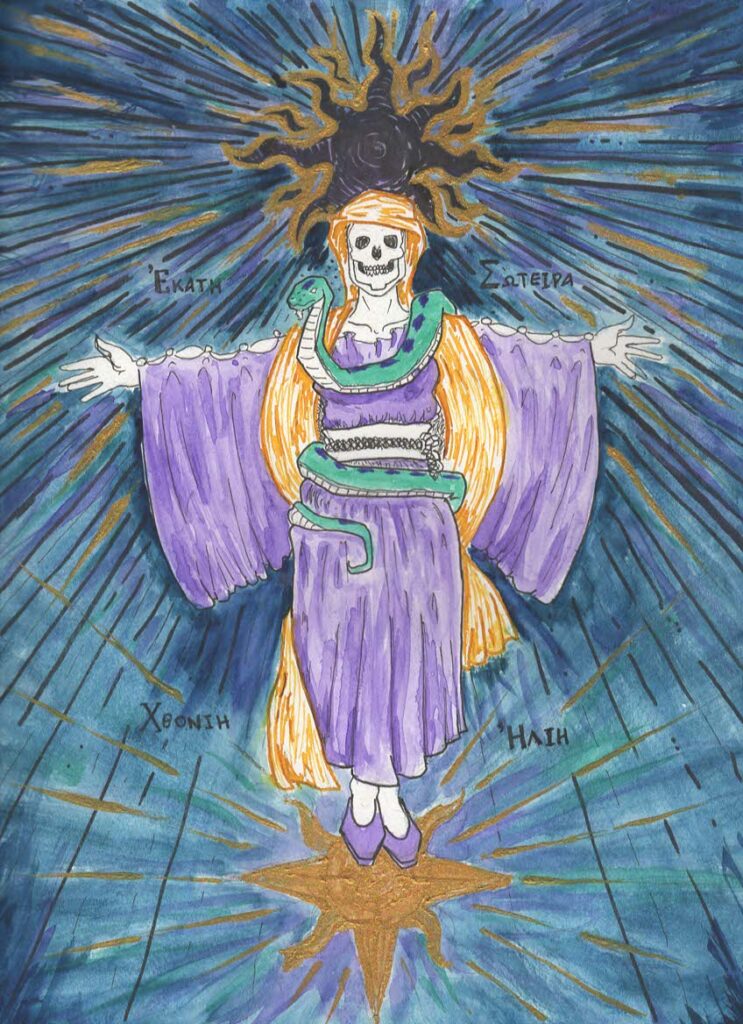
Devotional Image of Hekate as Chthonic Sun

Devotional Image of Hekate as Chthonic Sun

Hekate! Soteira! Chthonia! Helia!

Behold, Hekate as the Chthonic Sun. Justice and oathkeeper of the underworld.

I don’t know, precisely, what it means. I need to be clear on that from the outset. To the best of my knowledge, there is no historical precedent: Hekate is not descended of Helios, like the other great witches of Greek myth (Pasiphae, Circe, Medea). She is traditionally associated with the light of torches. Traditionally, she is sister to or even synonymous with the moon. But she is also Ourania: heavenly. And she is the the lightbearer: Phosphorus.

This epithet and its accompanying image first appeared to me during my morning ritual some time in January. I wish that part of the operation made a better story, but not all mystic visions come amidst lurid ecstatic rituals or in a drug-induced haze (most of mine don’t, honestly, which is both a relief and a disappointment). I stewed on the image for a couple weeks before I produced the first pencils, which I am still extremely pleased with. A few days later, I redrew the image on watercolor paper. I inked the image the night of the Full Moon, and have spent the last week applying watercolors over three sessions.
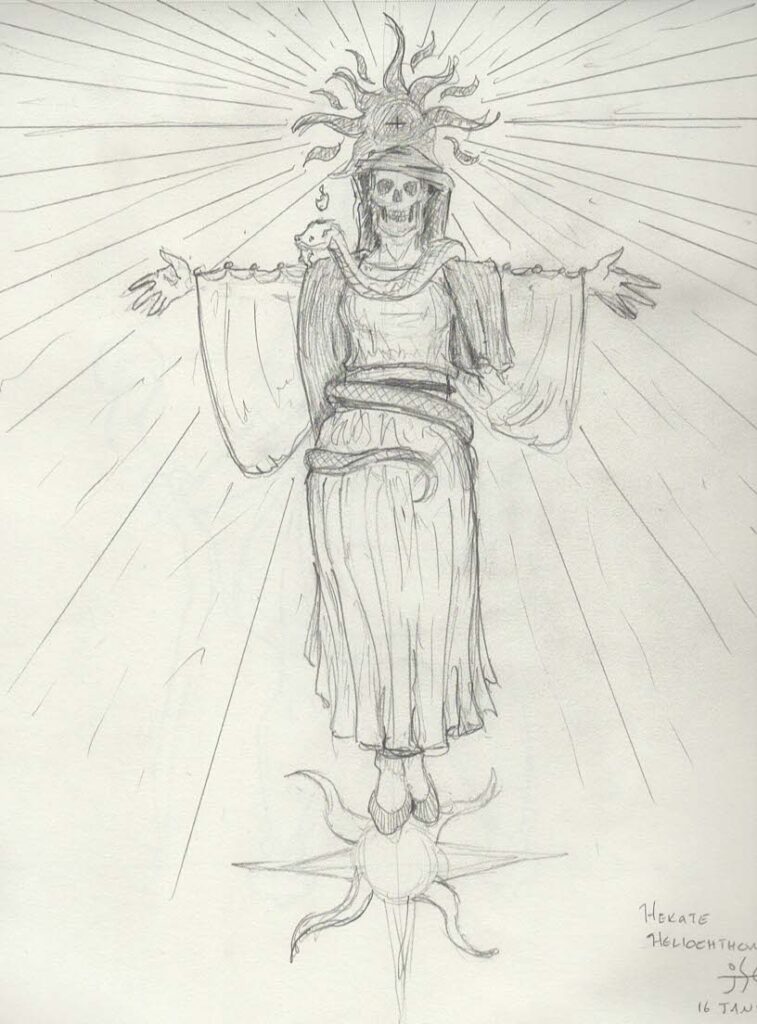
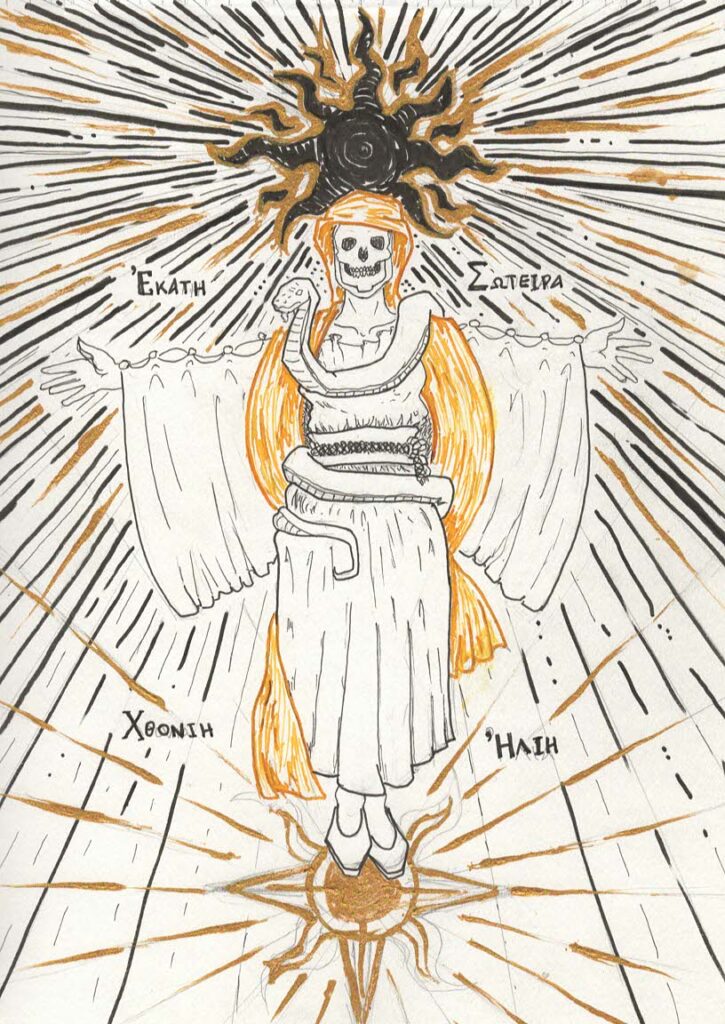
Artistically, this image was very much a series of experiments. I rarely re-draw anything after I’ve been as pleased with the pencils as I was with this, but the first draft was in my sketchbook and I needed it to be on watercolor paper. I’ve played around with watercolors a little bit, but not in years. Most of the color scheme was planned from the beginning, but the lavender robe was a very last-minute decision/inspiration. (I also considered pale blue, and almost left it paper-white.) I was not at all certain that I’d gotten my order of operations right – should I have done the watercolors between the penils and inks? After the black lines but before the gold? But the gold held up to the watercolor beautifully, and while I did ultimately decide to repaint the gold on both suns, I only needed to touch up a handful of the radiating gold lines, and ultimately found that layering of color and texture to be exactly what the image needed.

The scan obviously didn’t capture the metallic gold ink the way I’d like; it washed out the background a little, and almost completely ate the purples and greens. Strangely, it also increased the saturation of her lavender chiton. I may yet fuck with that. I still plan to digitally ink the scan of the original pencils, and may well do another watercolor and ink version, as well, just to see if I can do it better. Eventually, I’ll either mat or frame it for my altar. Some day, I might make them for sale. For now, though, I think I’m just going to bask in how well this turned out.

For those wondering about the Greek words around her, they are (going clockwise from the upper left): Hekate, Soteira, Kthonie, and Helia. The last (with the final eta rendering into English as an “a” like Athene -> Athena), for those who haven’t studied Greek, is a slapdash and technically unnescessary but probably not wrong feminization of Helios, which yes is the name of the Titan but also just the Greek word for “sun”.

Finally, it would be inappropriate to post this without linking to the art of Micah Ulrich, whose art so obviously influenced my composition.

ξένια: The Ethical Implications of Hospitality and Witchcraft

Behold, ξένια (xenia):

“… There you have my lineage.  That is the blood I claim, my royal birth.”

When he heard that, Diomedes spirits lifted.  Raising his spear, the lord of the war cry drove it home, planting it deep down in the earth that feds us all and with winning words he called out to Glaucus, the young captain, “Splendid–you are my friend, my guest from the days of our grandfathers long ago!  Noble Oeneus hosted your brave Bellerophon once, he held him there in his halls, twenty whole days, and they gave each other handsome gifts of friendship.

…

Come, let us keep clear of each other’s spears, even there in the thick of battle.  Look, plenty of Trojans there for me to kill, your famous allies to, any soldier the god will bring n range and I can run to ground.  And plenty of Argives too–kill them if yo can.  The men must know our claim: we are sworn friends from our fathers’ days till now!”

Both agreed.  Both fighters sprang from their chariots, clasped each other’s hands and traded pacts of friendship.

— Iliad VI.251-279.  Translated by Robert Fagels.  Penguin (1990).

From ξένος, “stranger” (though, specifically a civilized neighbor, not βαρβαρος ) and often translated as “guest-friendship”, ξένια was the ancient Hellenic practice of hospitality that assured travelers a safe place to stay, on the one hand, and the good behavior of guests on the other.  In a very real sense, the reciprocal obligations obligations of hospitality among mortals mirrored the reciprocity of piety and patronage between mortals and gods: it was a covenant.  Guest and host honored their duties alike, because it was one of the founding ethics of their society; to fail to do so invited chaos.  The central conceit of the Iliad, after all, is that Paris/Alexandris violated the terms of hospitality when he abducted Helen (willingly or unwillingly, the primary text is unclear … and how does being brainjacked by Aphrodite, as Helen implies she was at III.460-5, calculate into discussions of consent?), and the otherwise un-unified whole of Greece went to war for it.  For further examples, the whole Odyssey is basically a treatise on what goes wrong when you violate the terms of hospitality.

This is one of the Hellenistic practices that translates almost directly into my own life: all who come under my roof come under my protection–for the duration of their stay, at the very least.  Those who partake of my hospitality may always expect (at the very least):

  • clean water, and what food and booze I can afford to share (all my friends being as poor as I am, that painful caveat is mutually understood)
  • a safe place to stay at the end of the party and an intervention of they are too intoxicated to travel on their own
  • a safe place to stay when traveling through my territory
  • the use of my shower and laundry facilities
  • that, barring simple accidents, their bodies and property are safe within my territory
  • that they may always request a change of subject, excepting only if an intervention is taking place
  • that, while sexually charged situations may arise, sexually predatory behavior will never be permitted
  • that, should anyone encroach upon them, I will always take their side

But the idea of sacred hospitality also intersects, in my mind and heart, at least, with Hermetic notions of the Kingdom and with my feminist notions of witchcraft.  For those who partake of my hospitality on the regular, the protection follows them home.  And, however problematic it may be, I expect the same of them.   They are allied nations, in a sense, and the standards by which I judge the hospitality they offer are raised considerably.  Although I have never been handed this law as a taboo, it is the only position I can hold given my particular background of neo-Hellenism, Hermetics, and feminist witchcraft.  Simply put, fair or not, I hold the hospitality of others to my own ethical standards as a matter of spiritual obligation.

The thing of it is, though, these are not just words.  Ideas have consequences–ethics in particular.  What does one do, then, as a modern neo-Pagan neo-Hellenistic feminist witch, the divinely-charged manager of one’s own spiritual world, when one learns that a friend–the lord of an allied Kingdom–has grossly violated the laws of hospitality?

Clever readers will have already noted that this is a particularly neo-Pagan spin on one of the fundamental issues in feminism and other social justice movements: how do we police our own spaces?  What is the best way to respond to racist, sexist, and homophobic language when it’s coming out of the mouths of people we love?  What do you do when your friends exhibit sexually predatory behavior?

I don’t have the answers to these questions, unfortunately.  Confronting bigots in the wrong way often leads to them doubling-down on heir biases; socially isolating predators can lead to faster escalation.  Do we bind them then?  Curse them into oblivion?  Feed them to the Furies or to Tartaros, himself?  But I’m tired of seeing these issues blown off in Pagan circles as “divisive”, or being the fault of people who just can’t hack it (whether “it” be the liqour they’re drinking or the permissive atmosphere of festivals or whatever), or dismissed as “politics” and therefore unrelated to spirituality.

I am, however, hereby formally proposing that, at the very least for those of us who see a sacred component to hospitality, these are issues of spiritual consequence.