Astrological Images: Fixed Star(s) Pleiades

Under the constellation of Pleiades, they made the image of a little Virgin, or the Figure of a Lamp; its reported to increase the light of the eyes, to assemble Spirits, to raise Winds, to reveal secret and hidden things. – Henry Cornelius Agrippa, Three Books of Occult Philosophy, Book II, Chapter XLVII (1)

The second Fixed Star in the lists I’ve found, and the second to receive full treatment in this series, is the constellation Pleiades, a cluster of six stars most famous for their near-universal recognition across times and cultures.

De Quindecim Stellis (2), a treatise on the fixed stars, describes the Pleiades as “of the nature of the Moon and the complexion of Mars”. This “nature and complexion” scheme is reported for each of the fixed stars, and if we’re being honest, I don’t know exactly what that is meant to mean. It also gives the stone of the Pleiades as “crystal” or “diadocos”, neither of which can be mistaken for clear identifications, and the herbs as fennel and frankincense. Other texts included in De Quindecim give quicksilver as the metal of the star, and suggest including it in talismanic rings.

Similar to, if not outright drawing on Agrippa, the lapidary Speculum Lapidum gives this image as, “A virgin or a young woman or a torch…” (3), and the Hebrew name of the constellation (at least, according to De Quindecim Stellis) is “the Lamp”, giving a strong through-line to the images.

Warnock reports that the Pleiades constellation, as marked by their brightest star, Acyone, is currently at 0 Gemini 14.

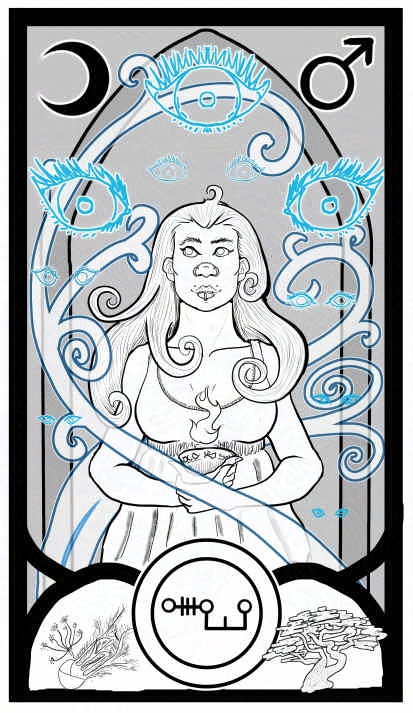
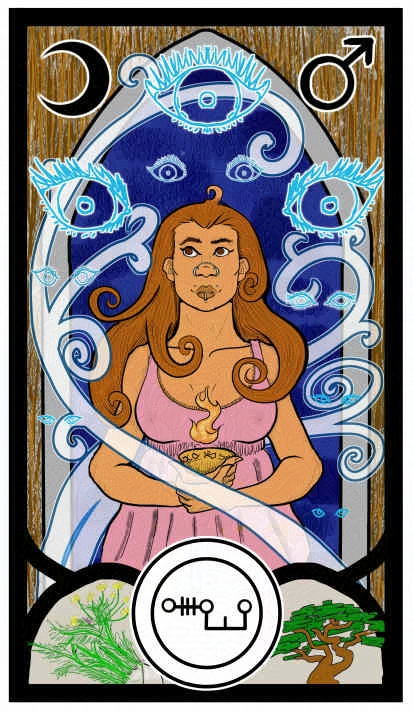
Nigel Jackson’s image in Warnock’s Fixed Star Magic (4) is a woman with a lamp beholding disembodied spirits and buffeted by winds. I chose a similar theme but wildly different visual composition: a portrait more suitable to a tarot-sized card in the Art Nouveau-inspired style and framing that I’ve been exploring over the last couple months, with seven sets of glowing spirit-eyes numbered for the Seven Sisters but not actually meant to represent them, and a spiral of winds around the central figure and her lamp. The bowl-shaped lamp is marked with the Agrippan Characters of the Moon. Yes, she has an Adam’s apple. Yes, that’s the now-slightly-dated trendy nose-ring chain.

Overall, I am exceptionally pleased with this image. I love her face. I love how the winds turned out. The eyes came out way better than I thought I could pull off. I think I did a fantastic job of a minimalist and suggestive background. I believe that she is having a mystical experience. And I think that the colors really work.

Admittedly, I am less happy with the fennel and frankincense at the bottom. Frankly, they were just much, much harder to draw than the hellebore and mugwort I did for Algol, even if I were more of a plant. This, of course, is why I drew the plants instead of the stones.

As you can see, I produced two versions: one mostly black and white with just a bit of color pop, meant to be easily printable for at-home use, and one full color, because this image really called for me to push myself.

For all that the Pleiades are held to be bad stars to be born under, and that fixed star elections are notoriously difficult to catch, I have found the spirits of these stars to be extremely amenable to sorcerous contact. I made my first such contact made during morning ritual with the aid of my Third Lunar Mansion talisman spirit (the 3rd LM is associated with the Pleiades), from which I got my first inkling of the image I would make, and a sense that a full-scale conjuration would be a good way to dial in both the art and the magic.

I made my second contact with the spirits of the Pleiades on the Day of the Moon during the hour of Mars, using the triangle of conjuration taught to me by Saturn (6) and a variation on the invocation in Warnock’s Fixed Star Magic, which combines a prayer written by Nigel Jackson with a PGM invocation. The spirits of the Pleiades approved the sketch i had done for my Image with a few editorial adjustments: more eyes, more winds. They also recommended that I substitute either archangel’s seals or the Picatrix planetary glyphs for the Agrippan Grand Planetary Seals that I used.
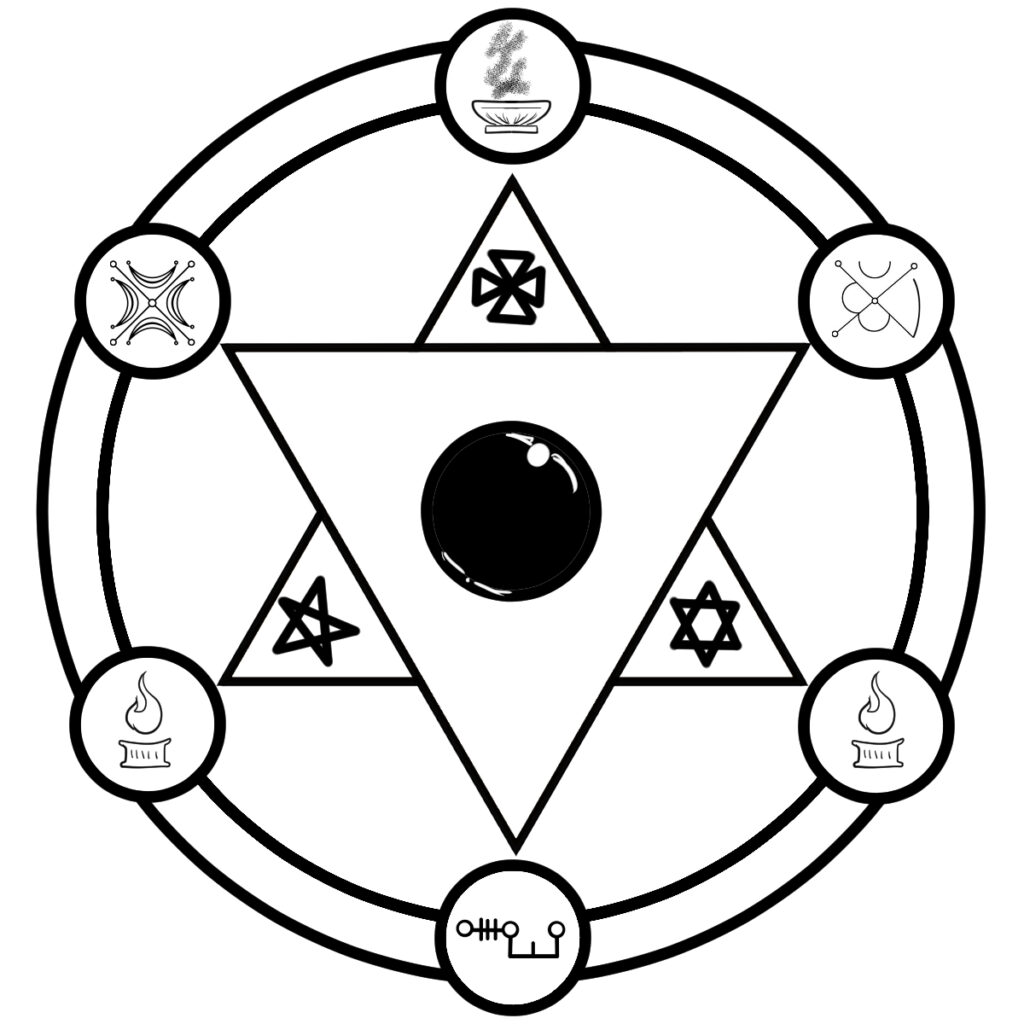
The spirits also told me to carry the Pleiades glyph that I had made for the conjuration ritual with me when I went to continue my work on the image. When I went to do so the next day, the paper lamen was hot to the touch, and my vision of the image stayed sharp and clear. In fact, it was a real struggle to put down my stylus and turn off the computer at the end of the day: I’d save the image, take one last look, and find myself tweaking some other little part.

Third contact was made on the Day of Mars during the Hour of the Moon, with the Grand Planetary Seals of the Moon and Mars switched out for seals of the archangels Gabriel and Sammael, as previously instructed. I had originally intended to repeat my Moon-day/Mars-hour invocation from the week before, but Monday … did not work out. Tuesday morning divination indicated that an additional conjuration/contact was unnecessary, but not unwanted.

The spirits came clearly and quickly. I asked to know them, and to be initiated into their mysteries, and they answered. The point of planetary seals was clarified somewhat: one should call them by the Lunar and Martial powers that one knows best, not by Gabriel and Sammael, in particular.

They confirmed, both explicitly and implicitly, that any combination of Lunar and Martial days and hours is a good time to conjure them. They told me to call on them under the waxing moon for their aid in seeing and commanding spirits of the upper air, and to call them under a waning moon for power over the dead, and to call upon them at any time for power over the winds: as messengers across the spirit world, and to raise and calm storms. They did not say, specifically, when to call them to clarify sight or to reveal hidden things; perhaps those are more closely associated with Pleiades talismans, only, but more likely they come with closer friendship.

They told me that rites of the Fixed Star Pleiades (with a bit of hopefully obvious modification) can be used to call up any of the sets of seven associated with the constellation, but that one must start from the beginning with each septet – that is to say, friendship with the daughters of Atlas and Pleione will win you no favors with the Babylonian MUL.MUL goddesses(5).

And they gave me this invocation to share with you:

I call upon you O Pleiades, you Seven Sisters: Alcyone, Maia, Electra, Taygete, Celaeno, Sterope, Merope. Under the auspices of the Moon [NN] and of Mars [NN], I call you. By Zizaubio, your messenger, I call you. Come to my circle. Shower me with your power, your spirit, your pneuma. Initiate me into your mysteries and [do the deed i wish].

Hail unto you, O Pleiades. Hail unto you Seven Sisters. Hail unto you, Alcyone, Maia, Electra, Taygete, Celaeno, Sterope, Merope. Daughters of gods, mothers of heroes, you who guard the gates of the ecliptic, I honor you. Initiate me into your mysteries and [do the deed i wish].

O you Pleiades, beautiful nymphs. O you mighty Seven Sisters. O Alcyone. O Maia. O Electra. O Tygete. O Celaeno. O Sterope. O Merope. I thank you for your presence in my circle. I thank you for the gifts of your mysteries. I thank you for your mighty deeds on my behalf, [the deed you wish]. As you came in power, go in peace with my gratitude.

Between the research – which I can hardly claim to have finished – the conjurations, and the illustrations, this image was significantly more work than the image of Algol. I had some concern that I would not be able to finish this post this month. I am both excited to continue to develop my relationship with the Pleiades, and extremely glad to be done with this image.

The next in the series will be Aldebaran, which comes third in those lists where he doesn’t trade places with Algol for first. I’ve done an Aldebaran image before, but I can’t recall that I’ve ever caught a proper election, which means that I will have a lot less previous relationship to draw on as I start my new illustration and do my conjuring. Still, I’m really looking forward to it, and I hope that you are, as well.


1 – Agrippa, Henry Cornelius. Three Books of Occult Philosophy. Book II, Chapter XLVII https://esotericarchives.com/agrippa/op2.htm

2 – De Quindecim Stellis: The Comprehensive Translations of Hermes on the Fifteen Fixed Stars. 2022. Various authors. Translated by Regulus Hess, edited by Christopher Warnock. This book also includes excerpts from several other texts, including the Speculum Lapidum.

3 – Leonardi, Camillo. Speculum Lapidum. Pennyslvania State University Press. 2023. Translated by Liliana Leopardi. (Hess and Warnock render this “A virgin or maiden, or a torch” in their excerpt in De Quindecim Stellis.)

4 – Warnock, Christopher. Fixed Star, Sign & Constellation Magic. 2019. Image by Nigel Jackson. Page 28.

5 – MUL.APIN. https://en.wikipedia.org/wiki/MUL.APIN

6 – I am very seriously working on my baseline conjuration ritual writeup, but in the meantime this link will take you to a pretty good explanation: https://journeythroughtheobsidiandream.com/index.php/2023/06/16/triangles-of-the-art-an-idiosyncratic-journey/
Picatrix Image of Jupiter According to Apollonius

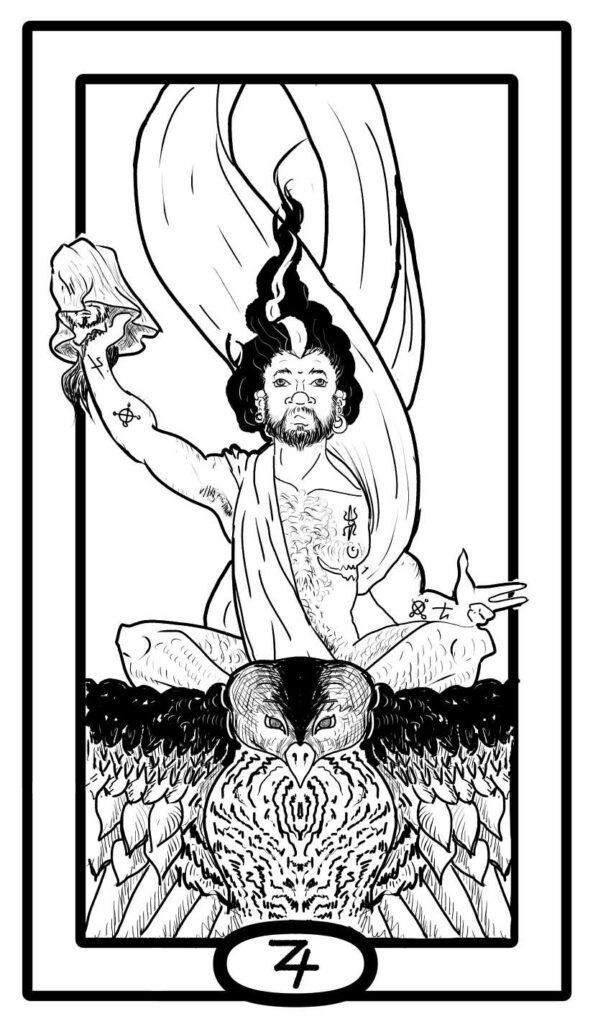
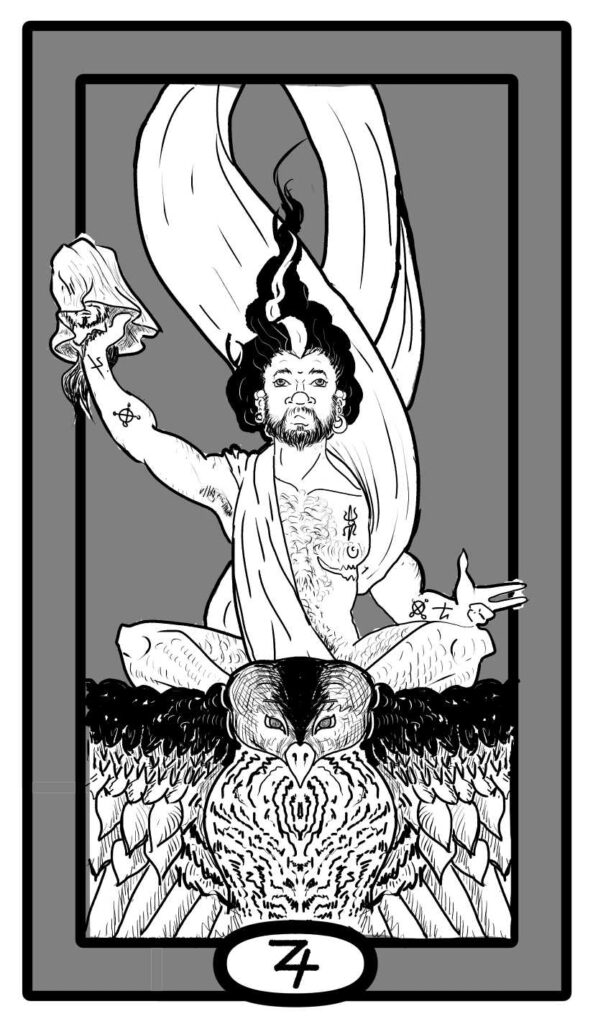
“The Image of Jupiter, according to the opinion of Apollonius, is the shape of a man sitting on an eagle, wrapped in a cloth, with his feet on the eagle’s back, and a head, covered by a cloth, held in this right hand. This is his shape.” -Picatrix Book II, Chapter 10, Paragraph 15 (Attrell and Porecca, 2019)

Behold, my latest Picatrix astrological image, Jupiter According to Apollonius”, my third Image of Jupiter following “… According to Picatrix” and “… Mercurius”.

The man and the eagle are obvious elements for an image of Jupiter. The head is less obvious. Having taken Gil the Dragon’s argument that the lion-headed image of Jupiter according to Picatrix is a callback to Herakles, similar lines of thought lead me to take the severed head here as a callback to Algol and Medusa, which would make this figure a rendition of Perseus.

As with all of these images, the vague description left me with a lot of room to make creative design decisions. I took “wrapped in a cloth” here the same way I did on my Mercurius image because it fit with the flying motif, because I like the continuity it adds between the two Jupiter images, and honestly because it’s just so much fun to draw. I chose to depict Jupiter as a hairy trans man with visible top surgery scars for mostly the same reasons I made the Mercurius image fat: because it’s fun, because it looks cool, and to add a bit more diversity to my imagery.

The eagle was a real technical challenge on account of I don’t have a lot of practice drawing birds. I based this one on a photo I found of a European imperial eagle in flight. The drawing is imperfect, but the fact of the matter is that real birds aren’t ever actually majestic, they’re all just that funny looking. And I’m proud of the feather patterns if not the degree to which it turned out more stylized than the figure.

The head he’s holding up, though, gave me a little bit of pause. From a design perspective, it was a challenge to navigate showing enough of the thing he’s holding under its cloth to be clear that it’s a head without reducing the cloth to the point where it looks like a doily hat. Plus the inevitable question of why the cloth isn’t blowing away in the wind that’s billowing Jupiter’s hair and the cloth he’s wearing. Ultimately, I went for intelligibility over realism, and I think that it looks pretty fucking good.
Also, while I do think that I am persuaded by my own speculation that the severed head is supposed to be (or at least evoke) Algol/Medusa, I chose to render it as a bearded man’s head for the sake of intelligibility at the intended scale of print (tarot car size).

The completion of this Image of Jupiter marks the completion of my first full set of Picatrix images: all seven planets as described by Apollonius. I’ve been thinking about that fact all week as I’ve wound up to finishing the image and writing this post, but I think I have a bit of processing to do before I say more.
Now, finally, what are the magical uses of this image?

Modern magicians emphasize the wealth and abundance aspects of Jupiter, and those are absolutely present in the Picatrix:
“Entreat Jupiter for the accumulation of wealth…” (Book IV Chapter 4, Para 6)
“Jupiter [is the substance of] the power of increase” (Book IV, Chapter 4, Para 55)
More, though, the Picatrix speaks of Jupiter of the planet by which one extracts justice and favor from rulers, and for spiritual pursuits. Health (physical and mental) and safe travel also get honorable mentions.
“… the benevolence of Jupiter is appropriate to the works of clergymen, kings, and lords” (Book 2 Chapter Three Para 5)
“Jupiter is the source of growing power. He governs an aspect toward law, legality, jurisprudence, and the ease of acquiring requests, reparations, and restraints. He guards against mortal illness. He governs wisdom, philosophy, and the interpretation of dreams. … Among the crafts, he governs ruling, jurisprudence, and selling pristine merchandise.” (Book 3 Chapter 1 Para 4)
“Jupiter is the author of life and the sciences. Laws, treaties, and judgements proceed from him.” (Book 3 Chapter 3 Para 33)
“Entreat Jupiter for … the enhancement of dreams, the pleasure of escaping sadness, the leaving behind of toil and quarrel, and safe journeys by land or sea.” (Book 4 Chapter 4 Para 6)

Gandalf Style?

Gandalf Style?

_DSC7042
Dramatic lighting is my friend.

Last week’s Sexy Pagan Friday offering is as good a place as ever to start off a little rambling about what has probably been my most significant magical practice since returning to KCMO.

Most of my effort, magical and otherwise, has been devoted toward settling in: to establishing my space, and to being in the right place at the right time.  Notice all the green in that photo: my hat, my scarf, my pocket handkerchief, the shirt you really can’t see because I got super dramatic with the lighting, and even my fucking socks are green.  Zip back through my last few spf posts, and you’ll find a shit ton of green in them, too.

_DSC7048
Saturdays I dress in black. The purple tie is usually for Mondays, but I was just feeling extra fabulous last week.

Taking a cue from Aradia, who did this diligently before she quit her office job back in June, I’ve been incorporating planetary colors into my clothing as much as possible.  (Wednesday is a fucking challenge: I look absurd in orange, which basically leaves me shit out of luck.)  It’s a simple, mindful thing, rather than an act of overt magic, but it’s something.  (Mondays are my favorite because purple.)

This also goes back to something I’ve touched on before: crafting a new image for myself as I become too old–and too committed to “professional” life–to let my freak flag fly full time.  Since then I’ve learned that I receive very different from both the mallgoers who patronize my jewelry store and the coworkers who’ve known me for six fucking years now when I wear a tie and nice shoes.  Simply put, they take me more seriously.   (This, of course, should come as a surprise to no one.)

And, I will say, it sure helps that men’s fashion has gone in some pretty awesome directions since I made this decision.  Vests are seriously back in style.  Colors and patterns are vibrant and fun.  And pocket squares!

It’s difficult to gauge the efficacy of general prosperity magic–yeah, I’m doing pretty alright, but I’m also busting my ass–but judging by the ways in which I do seem, increasingly, to be in the right place at the right time, I believe that I can call the experiment, at worst, a moderate success.  The things I want to buy are on sale and in my size, I sit down at the right table to meet close friends of the hosts of open events, people respond to my messages on OKC, the art store has a shipment of the strange craft supplies I’m after in the deep discount corner of the basement.

I want to escalate this shit.  I bet I can make a talisman out of a tie or a pocket square.  Can you enchant a suit?  I’ll fucking find out!  (And you can’t tell me no one has never tried.  The question is, did they blog about it?)

John Fucking Constantine
Solid character. Not a role model.

But it kinda fucks with my head.  I mean, yes, these are magical successes, in a sense, and I am having a good time with it.  But it’s all so fucking butch.  I no longer fit my own image of a witch, or even a wizard or a sorcerer.  I mean, there’s some precedent for a magician playing the straight man… but being a magician did some fucked up shit to my head: Aradia was preparing to stage an intervention.

The realistic solution is probably to get better at code switching: taking off the work costumes as soon as I get home and putting on clothes that are more in line with my self-image; finding times and places where those clothes are more appropriate.

And keep doing magic.

Always do more magic.


ξένια: The Ethical Implications of Hospitality and Witchcraft

Behold, ξένια (xenia):

“… There you have my lineage.  That is the blood I claim, my royal birth.”

When he heard that, Diomedes spirits lifted.  Raising his spear, the lord of the war cry drove it home, planting it deep down in the earth that feds us all and with winning words he called out to Glaucus, the young captain, “Splendid–you are my friend, my guest from the days of our grandfathers long ago!  Noble Oeneus hosted your brave Bellerophon once, he held him there in his halls, twenty whole days, and they gave each other handsome gifts of friendship.

…

Come, let us keep clear of each other’s spears, even there in the thick of battle.  Look, plenty of Trojans there for me to kill, your famous allies to, any soldier the god will bring n range and I can run to ground.  And plenty of Argives too–kill them if yo can.  The men must know our claim: we are sworn friends from our fathers’ days till now!”

Both agreed.  Both fighters sprang from their chariots, clasped each other’s hands and traded pacts of friendship.

— Iliad VI.251-279.  Translated by Robert Fagels.  Penguin (1990).

From ξένος, “stranger” (though, specifically a civilized neighbor, not βαρβαρος ) and often translated as “guest-friendship”, ξένια was the ancient Hellenic practice of hospitality that assured travelers a safe place to stay, on the one hand, and the good behavior of guests on the other.  In a very real sense, the reciprocal obligations obligations of hospitality among mortals mirrored the reciprocity of piety and patronage between mortals and gods: it was a covenant.  Guest and host honored their duties alike, because it was one of the founding ethics of their society; to fail to do so invited chaos.  The central conceit of the Iliad, after all, is that Paris/Alexandris violated the terms of hospitality when he abducted Helen (willingly or unwillingly, the primary text is unclear … and how does being brainjacked by Aphrodite, as Helen implies she was at III.460-5, calculate into discussions of consent?), and the otherwise un-unified whole of Greece went to war for it.  For further examples, the whole Odyssey is basically a treatise on what goes wrong when you violate the terms of hospitality.

This is one of the Hellenistic practices that translates almost directly into my own life: all who come under my roof come under my protection–for the duration of their stay, at the very least.  Those who partake of my hospitality may always expect (at the very least):

  • clean water, and what food and booze I can afford to share (all my friends being as poor as I am, that painful caveat is mutually understood)
  • a safe place to stay at the end of the party and an intervention of they are too intoxicated to travel on their own
  • a safe place to stay when traveling through my territory
  • the use of my shower and laundry facilities
  • that, barring simple accidents, their bodies and property are safe within my territory
  • that they may always request a change of subject, excepting only if an intervention is taking place
  • that, while sexually charged situations may arise, sexually predatory behavior will never be permitted
  • that, should anyone encroach upon them, I will always take their side

But the idea of sacred hospitality also intersects, in my mind and heart, at least, with Hermetic notions of the Kingdom and with my feminist notions of witchcraft.  For those who partake of my hospitality on the regular, the protection follows them home.  And, however problematic it may be, I expect the same of them.   They are allied nations, in a sense, and the standards by which I judge the hospitality they offer are raised considerably.  Although I have never been handed this law as a taboo, it is the only position I can hold given my particular background of neo-Hellenism, Hermetics, and feminist witchcraft.  Simply put, fair or not, I hold the hospitality of others to my own ethical standards as a matter of spiritual obligation.

The thing of it is, though, these are not just words.  Ideas have consequences–ethics in particular.  What does one do, then, as a modern neo-Pagan neo-Hellenistic feminist witch, the divinely-charged manager of one’s own spiritual world, when one learns that a friend–the lord of an allied Kingdom–has grossly violated the laws of hospitality?

Clever readers will have already noted that this is a particularly neo-Pagan spin on one of the fundamental issues in feminism and other social justice movements: how do we police our own spaces?  What is the best way to respond to racist, sexist, and homophobic language when it’s coming out of the mouths of people we love?  What do you do when your friends exhibit sexually predatory behavior?

I don’t have the answers to these questions, unfortunately.  Confronting bigots in the wrong way often leads to them doubling-down on heir biases; socially isolating predators can lead to faster escalation.  Do we bind them then?  Curse them into oblivion?  Feed them to the Furies or to Tartaros, himself?  But I’m tired of seeing these issues blown off in Pagan circles as “divisive”, or being the fault of people who just can’t hack it (whether “it” be the liqour they’re drinking or the permissive atmosphere of festivals or whatever), or dismissed as “politics” and therefore unrelated to spirituality.

I am, however, hereby formally proposing that, at the very least for those of us who see a sacred component to hospitality, these are issues of spiritual consequence.

Full Moon Musings–November 2012

Over the course of the semester three new magical tools have come into my possession: a pentacle, a staff, and a black-handled knife.  The pentacle I picked up at a swap-meet hosted by the local pagan store.  The staff is hand-made by a fine gentleman in the local community, and was given to me as a gift.  The knife was also a gift, a birthday present from another friend here in IMG_5583Sunrise.  These were my first clues that it was time to get back to my basics.  I didn’t ignore the message, per se; I just couldn’t figure out how to enact it in the context of my current workload.

Read More